1. Upload Sheet Music to Suno (or skip to step 2)
Weirdness: LOW
Instrumental: YES (this is a piano solo — no vocals)
2. Paste Style / Genre Tags
1844 American parlor waltz, antebellum salon piano, 3/4 valse time, square pianoforte, Philadelphia music publishing, Henry F Williams style, period dance music, gentle lilt, 1840s domestic music, instrumental piano solo, dynamic contrasts forte to piano with crescendos, trill ornaments, melodic right hand with oom-pah-pah waltz bass, no drums, no electric instruments, no synthesizer, warm vintage recording, parlor dance, light and graceful, romantic but restrained, Frank Johnson Band tradition
3. Lyrics (none — instrumental)
[Soft Piano Introduction, gentle 3/4 waltz time, mp dynamic]

[Theme A - Forte, melodic right hand with waltz bass, light and dancing]

[Theme A Repeat - Piano (softer), more delicate, with grace notes]

[Bridge - Crescendo passage with trill ornaments, building toward forte]

[Theme B - Fortissimo, more elaborate, fuller chordal texture]

[Theme B Repeat - With variations and trills]

[Return to Theme A - Forte then piano]

[Coda - Final cadence with light trill, ending on tonic]
4. Generate & Select
About Henry F. Williams (1813–1903)
Biography
| Born | August 13, 1813, Boston, Massachusetts |
| Died | c. 1903, Boston |
| Music study | Began at age 7. Studied with Peter Albrecht von Hagen Jr., Alfred Howard, and Henry Thacker. Later graduated from the New England Conservatory of Music after it opened in 1867. |
| Instruments | Violin, double bass, cornet, violoncello, trombone, piano-forte, baritone trombone, tuba (and taught most of these) |
| Famous for | One of only two Black musicians to play in the orchestra at the 1872 National Peace Jubilee — performing Wagner’s Tannhäuser and the William Tell Overture |
| Collaborations | Worked with the Frank Johnson Band of Philadelphia; arranged music after Johnson’s 1844 death. Frequently arranged for Patrick Sarsfield Gilmore’s Band. |
| Notable works | Lauriette (1840, ballad), Croton Waltz (1844, this piece), Parisien Waltzes (1854, republished 1867), Chitarra Polka (1853), polkas, mazurkas, quadrilles, marches |
| Reputation | Called “the second best known black composer of his time after Frank Johnson” |
The Croton Connection
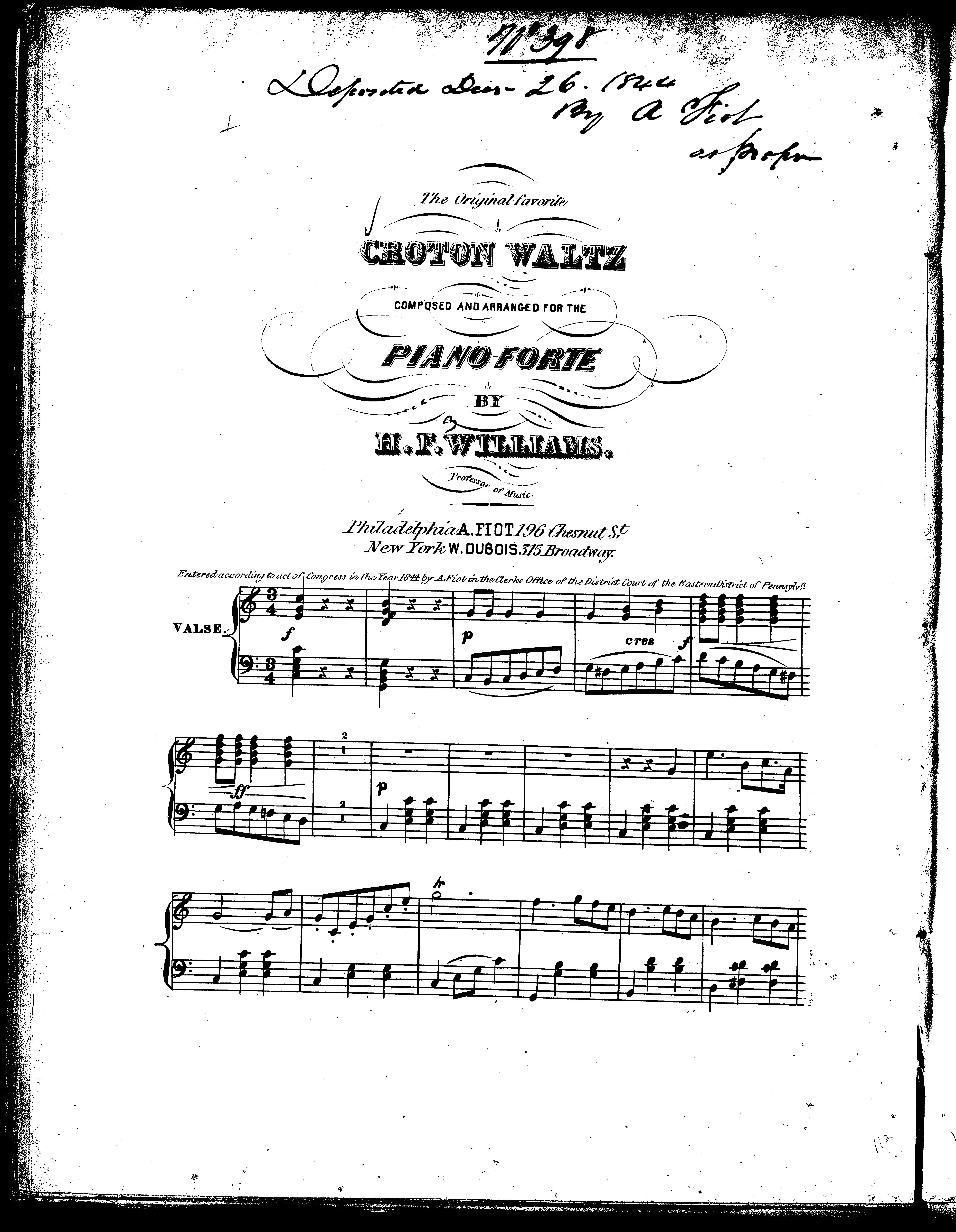
Williams composed his Croton Waltz in 1844, two years after the Croton Aqueduct opened New York City’s first public water supply. The piece was published in Philadelphia by A. Fiot at 196 Chestnut Street and in New York by W. Dubois at 315 Broadway. It was deposited for U.S. copyright on December 26, 1844 (manuscript no. 398 in the District Court of the Eastern District of Pennsylvania).
The same year, Williams was working as music arranger for Frank Johnson’s Band after Johnson’s death. Frank Johnson (c. 1792-1844) had been the most famous Black bandmaster in America — the first African-American to publish sheet music, the first to play before European royalty, and a pioneer of the brass band. When Johnson died in April 1844, Williams stepped into a leading role for Black American music.
That makes the Croton Waltz a doubly significant piece: a celebration of New York’s public water by a Black composer, written in the same year that he assumed leadership of the most important Black musical organization in the country. The fact that we still have the original sheet music — preserved by the U.S. Copyright Office and digitized by the Library of Congress — is a small miracle.
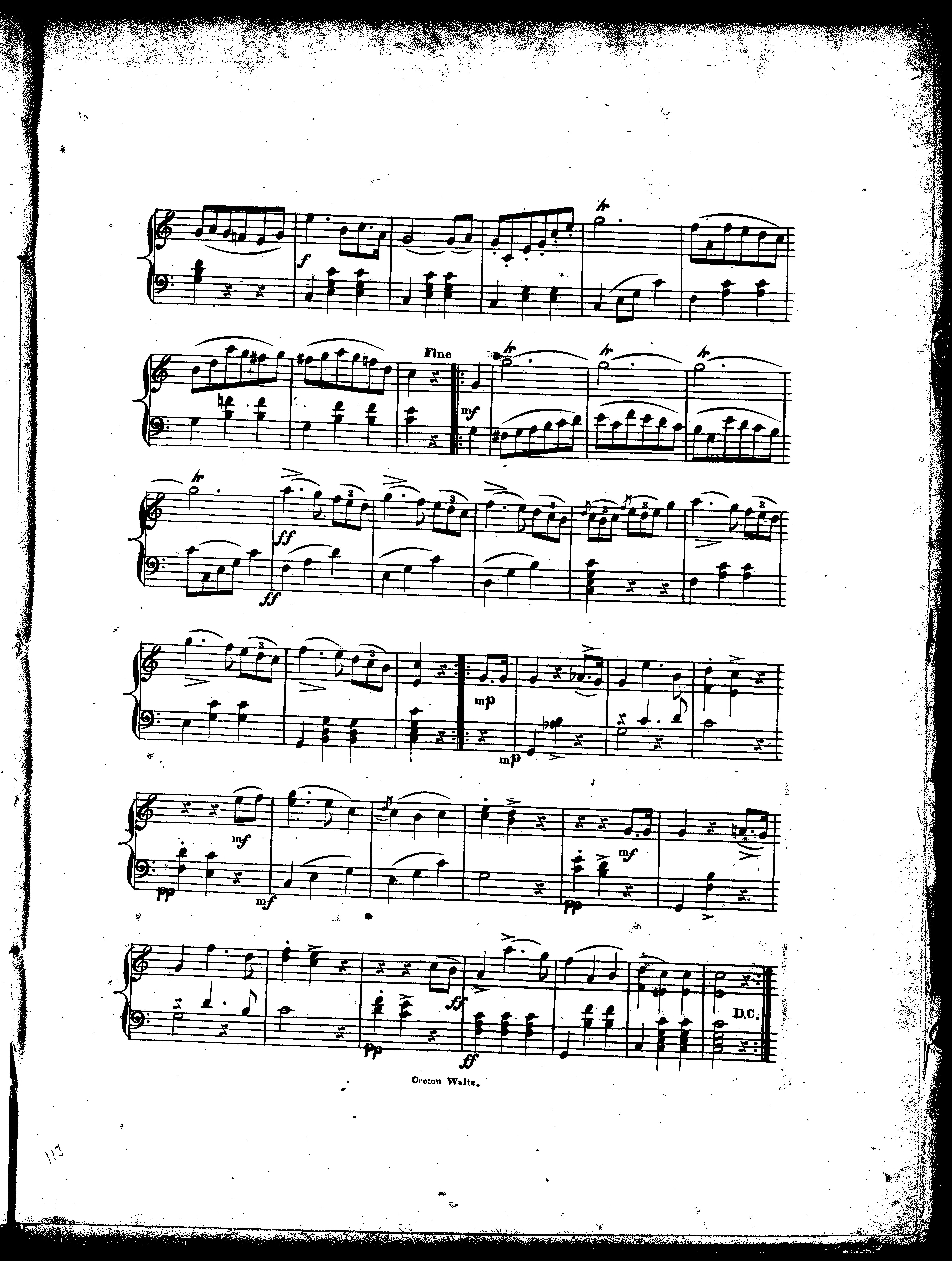
Original 1844 Sheet Music