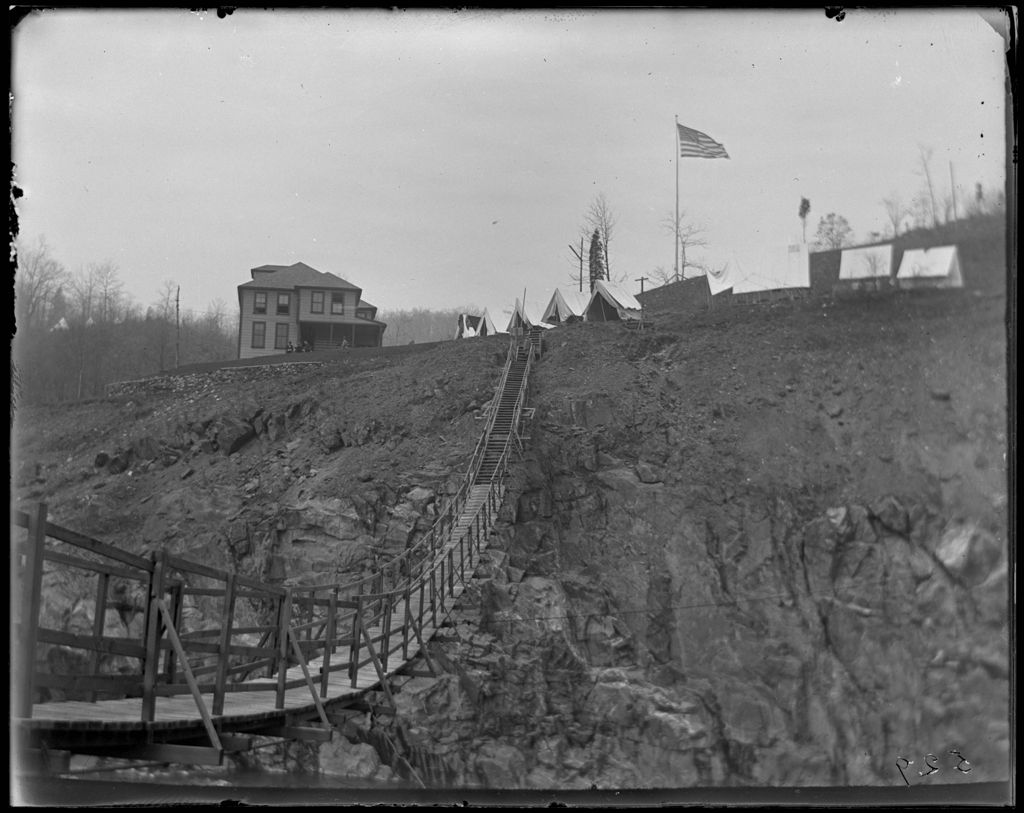
At 9:50 o'clock on the night of Monday, April 16, 1900, Sergeant Robert Douglass of the Eleventh Separate Company of the New York State National Guard at Mount Vernon was walking up a dark hill above the Croton valley to relieve the picket line. His post was inside a ring of sentries thrown around the works of the Cornell Dam, where roughly three thousand Italian laborers had been on strike for the previous fifteen days. He carried a Krag-Jorgensen rifle. He was twenty-six years old.
A single shot came out of the trees above him. The bullet entered his chest. He fell on the path, said one word, and died before the men who picked him up could get him down the hillside on a stretcher.
The Cortland Evening Standard of April 17, 1900, reporting under the headline "SERGEANT MURDERED / First Bloodshed in Croton Landing Strike," preserved the dispatch verbatim: "The first bloodshed as the outcome of the strike at the Cornell dam was the life's blood of Sergeant Robert Douglass of the Eleventh Separate company of Mount Vernon, who was shot dead by an unknown assassin while he was relieving guard at 9:50 o'clock last night. The wildest excitement prevailed throughout the camp as soon as the news of the assassination spread to the different tents."[1]
The search that followed turned up nothing. "It was pitch dark at the time," the Standard's dispatch continued, "but McDowell and the others fired a volley into a clump of bushes nearby without hitting anyone. No one saw the flash or heard the sound of the shot which killed Douglass, and it was a most mysterious affair." Lieutenant Glover led a squad to the hilltop and "made a thorough search, but failed to find any person there." The guards were pulled in from the outer perimeter and concentrated in the valley at the bottom of the works. Nobody was ever arrested for the killing.
Robert Douglass's death was the climax of a strike that had begun over wages and ended in a militarized occupation of a Westchester village. It was the first and only time in the history of the New Croton Dam's fifteen-year construction that a soldier of the state militia was killed by a shot from the hillside — and the first time, in Westchester memory, that a dispute between immigrant laborers and their American employers passed the threshold into armed conflict with the state. For three centuries of local history, the story of the dam has been told as engineering triumph. The story of what happened around it in April 1900 has been told almost not at all.
What the Strike Was About
The Cornell Dam — the name the workers and newspapers used for what the engineers called the New Croton Dam — had been under construction since 1892 under the superintendent John B. Goldsborough. By the spring of 1900, roughly three thousand laborers were living in two adjacent shantytowns: "Little Italy" up the hill above the dam works, and the "Bowery" along the banks of the Croton River a mile upstream from Croton Landing. The population was overwhelmingly Italian, recruited from the villages of Basilicata and Calabria through padrones — English-speaking labor brokers who contracted with the Cornell Company for workers in lots of 50 or 100 men.
The padrone system worked as follows. The broker advanced a worker's passage money from Italy. He charged a commission on the man's first month's wages. He operated the company store where the workers bought groceries, kept the rooming-house dormitories where they slept, and recorded the debts they owed him. Wages were classified in three tiers: "intelligent labor" at 30 cents a day more than "common labor," and common labor itself subdivided into white, colored, and Italian, with Italians receiving the lowest pay of the three. The arrangement made the padrones wealthy. It kept the workers in bondage to their debts.
In April 1899 the New York state legislature passed a law requiring an eight-hour workday for all public works. The Cornell Dam was a New York City public work. On April 2, 1900 — the day the new law took effect for the spring construction season — the padrones told their Italian workers that the rate would go down to compensate for the shorter day. The workers walked out.
What followed was not a normal strike. For fifteen days the men refused to return to the dam site, held daily meetings in the Bowery, and drilled openly with shotguns, revolvers, and stilettos. The local sheriff's deputies made a show of patrolling, but no one trusted the deputies — many of them were padrone clients themselves. Newspapers in New York City and Albany reported rumors of Italian anarchists arriving from the city. Governor Theodore Roosevelt, who had been in office just over a year and was already planning his run for vice president, began mobilizing the state militia.
The Shooting
The militia arrived at Croton Landing on the afternoon of Saturday, April 14, 1900. The first troops were the Eleventh Separate Company of Mount Vernon and the Fourth Separate Company of Yonkers — two companies under the immediate command of Major Denick in the absence of Colonel Emmett of the First Regiment, with orders from state headquarters in Albany to secure the works, protect non-striking laborers, and maintain order until the strike was broken.
The Cortland Standard's dispatch of April 17 captured the scene of the militia's arrival in the Bowery with unusual vividness. "Before the deputy sheriffs about the works knew of the arrival of troops in Croton valley the strikers were aware of it. There was a blowing of horns, and while the troops were resting at the station waiting for the word to move, 40 armed Italians carrying an American and two Italian flags crossed from Little Italy hill to the Bowery. They were cheered by the men in the Bowery and watched with interest by the deputy sheriff. Ten minutes after their arrival at the Bowery there were no weapons in sight."
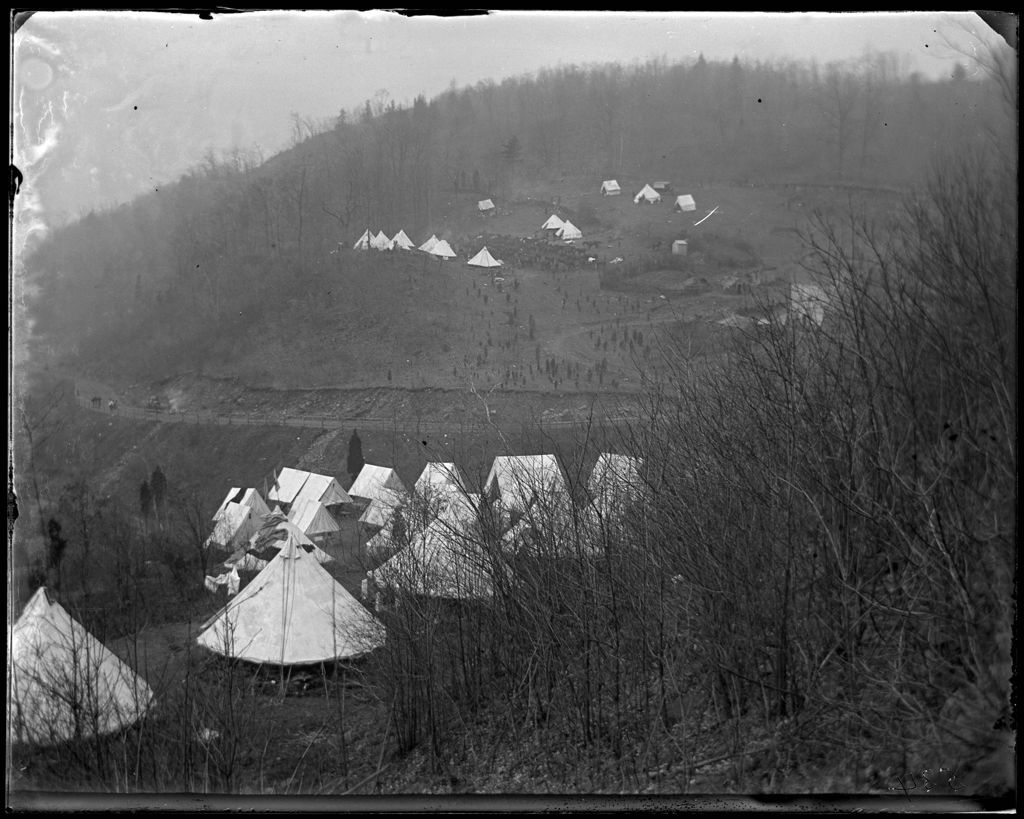
The march up the valley was tense but uneventful. A small accident — a cartridge exploding in a soldier's rifle — briefly panicked the advance guard, who "nervously pulled the triggers of their rifles and the bullets tore holes in the earth 10 feet in front of them." Nobody was hurt. As the column swung into the narrow lane called the Bowery, the men of the Eleventh Separate Company got their first look at the village they had come to suppress: "About 200 men were on the board sidewalks. Women were hanging from the windows and crowded on the stoops. About 20 Italians with mandolins and guitars were seated on the walk playing a lively tune. In the center of the street a woman about 60 years old, called 'Bowery Kate,' was dancing."[2]
The tents went up in the valley, on a bank of earth and stone taken from the dam's foundation excavation. "A line of pickets was thrown about the works on the hill where the strikers reside. A patrol was established at Bowery bridge and admission inside the lines was denied to all but persons with passes."[2]
Sergeant Douglass's post was on the picket line on the hill above the works. He stepped into the dark path at 9:50 PM on Monday, April 16. The shooter was never identified. There were no witnesses who had seen the flash, and the men who fired the retaliatory volley into the bushes never found the gunman. Douglass was carried down the hill to his tent, where he died.
Roe, Molloy, and the Twenty-Six
Within twenty-four hours of Douglass's killing, Governor Roosevelt sent additional troops. Brigadier General Charles F. Roe of the First Brigade of the New York National Guard arrived by special train to take command of the occupation. Cavalry from Troop C of the First Cavalry, at that time stationed at Ardsley, was marched to Croton Landing and deployed along the roads leading to both shantytowns. Infantry from Companies A and B of Yonkers and Mount Vernon maintained the perimeter.
The critical day was Thursday, April 19, 1900. Sheriff Molloy of Westchester County arrived at Roe's headquarters with thirty-two arrest warrants — some charging participation in an illegal armed assembly, some charging participation in the Douglass murder, and some charging specific individuals with threats and intimidation during the fifteen days of the strike. The Cortland Standard dispatch of April 20 preserves the tactical detail of what happened next:
"Since the arrival of the cavalry on Tuesday the strikers have been very quiet, and did not repeat their drills with the accompanying display of shotguns, rifles and revolvers. In fact the result of the raid would go to show that the arms have been carefully hidden away. From General Roe's headquarters orders were issued for the infantry and cavalry to be placed so as to prevent any persons escaping from either Little Italy or the Bowery. Cavalrymen from Troop C were posted along the roads leading out. The sheriff with 25 deputies, escorted by Company D of the Seventh regiment, searched houses in the Bowery for weapons and ammunition. 'There was not the slightest resistance.'"
In the Bowery, Sheriff Molloy's deputies arrested nine men. "Three of whom were Marcelo Rotella and his two sons, Angelo and Antonio. One revolver, a toy pistol, a few cartridges and several dirks and stilettos were found and confiscated."[3] Across the river in Little Italy hill, the sheriff's men rounded up another seventeen. The arrested prisoners — twenty-six in total — were taken first to the guard tent of the Fourth Separate Company, then marched to the Croton Landing depot for a special train to Tarrytown, and from Tarrytown by trolley to the jail at White Plains.
The Cortland Standard closes its April 20 dispatch with a detail that is easy to miss but significant: "The Mt. Vernon and Yonkers companies have broken camp."[4] The militia was already withdrawing even before the prisoners reached White Plains. The show of force had been as much theater as tactics — a demonstration aimed at the two hundred representative Italians who were at that moment meeting at the Hotel Colombo on Bleecker Street in New York City to discuss "some reasonable methods of settling the Croton dam strike."
That meeting, the Standard records, "ended in a riot."
What the Workers Got
By Saturday, April 21, 1900, the strike was over. Not through negotiation. Through exhaustion, arrest, and padrone eviction. "Fully 150 of the men who had struck for higher wages had gone to New York and Syracuse,"[5] the Cortland Standard noted — many of them packing up and leaving under threat from their own padrones, who stood to lose their contracts with the Cornell Company if the works sat idle much longer. Others left to avoid Sheriff Molloy's follow-up warrants. The strike did not secure higher wages. It did not secure the eight-hour day in practice. Mayor Seth Low's 1902 order making the eight-hour day mandatory for New York City public works came two years after the Croton strike had been broken — too late to do any of the men of the 1900 walkout any good.
The dam, begun in 1892, was ceremonially completed with the placement of the final stone on January 10, 1906, and was fully operational by 1907. By that date the Italian shantytowns along the Croton River had already begun to thin. Enos Higgins, who lived in Croton in the 1900s and published his memoir Croton on the Hudson: a Historical Sketch in 1940, captured the slow dispersal in a single paragraph: "Croton Lake rose to its high normal level and the water poured over the spillway to the delight of hundreds of thousands who have viewed it since. 'Little Italy' faded away and the colorful pay night became a memory. The cavalcade of wagons and trucks that had rolled and rattled down to Croton Landing every morning to receive the blocks of granite and tons of cement which kept pouring into Croton in endless profusion, ceased to operate. The greatest gain that came to Croton through this achievement was the permanent acquisition of the best Italian and American artisans who found the village congenial and a pleasing place to live. Our finest Italian residents date back to the building of the Croton Dam, and are among our best citizens."
Higgins is the closest thing we have to a first-person account of the post-strike village. He is writing forty years later and is gentle with the memory. He does not mention Douglass. He does not mention Sheriff Molloy. He does not mention the twenty-six arrests. The "colorful pay night" that became a memory was the rowdier night of the Bowery before the militia arrived — not the quiet night after, when the soldiers had left and the padrones had dispersed and the last handful of Italian families remained to become the founding population of Croton's Italian-American neighborhood along what is now Riverside Avenue and Truesdale Drive.
What Is Not Told
Three things about this story are worth holding separately.
First, Sergeant Robert Douglass is not on any published Revolutionary War or Civil War memorial in Westchester County. He was killed in a labor dispute, and labor disputes do not get monuments. His name appears in the Westchester County Historical Society's catalog only through our research page [Story 20 entry 34, The Sergeant at Twitching's](/story/20_original_research#34), which recovered his full regimental identity from the Cortland Standard dispatches. The earlier item in that research page (entry 11, on the 1900 strike) misidentified him in the first draft of the site; we corrected that in April 2026 and cross-linked the two entries.
Second, the name of the killer was never recovered. Contemporary reporting assumed, without evidence, that the shot came from an Italian striker. It could as easily have come from a deputy sheriff, a rival padrone, a private strikebreaker hired by the Cornell Company, or a settled neighbor with his own grievance against the militia presence. The Cortland Standard of April 17 records only that "it was pitch dark at the time" and that "no one saw the flash or heard the sound of the shot which killed Douglass." The assassin is preserved in the record only as "unknown." That is where the record should leave him.
Third, the Cornell Dam strike is the largest single-location labor action in the history of Westchester County — not counting the Irish aqueduct workers' strike of 1838 at the old Croton Dam (which was a smaller action) or the Croton Water Celebration of October 14, 1842 (which was not a strike at all, but the biggest civic parade in New York City history to that date). For the fifteen days between April 2 and April 17, 1900, roughly three thousand laborers at a single construction site shut down the largest public-works project in the United States in a coordinated refusal of work that went beyond any individual grievance and was settled only by the direct deployment of the state militia. No contemporary labor history of the Hudson Valley records it at this scale. No modern history of the New Croton Dam treats it as a labor story. It is recoverable here only because the Cortland Evening Standard's unnamed correspondent at Croton Landing filed four days of dispatches between April 17 and April 20, and because those dispatches were preserved in the paper's archives, and because Jeff Paine's transcription of the Cortland Standard in the 2010s made them searchable, and because we ingested them into history.db in April 2026.
If the shot that killed Robert Douglass had not been fired from the dark above the works, the Cornell Dam construction might have been completed without anyone outside Croton remembering that there had ever been a labor dispute at all. The shot is the reason the strike exists in the written record. The sergeant's body is the reason the history is tellable.
References
- Cortland Evening Standard, Tuesday, April 17, 1900: "SERGEANT MURDERED. First Bloodshed in Croton Landing Strike. SOLDIER SHOT BY ASSASSIN. Member of Mount Vernon Militia, While Relieving Guard, Suddenly Falls, Pierced With Bullet Fired By Unknown—Excitement Runs Wild Over Affair." Public-domain newspaper dispatch from Croton Landing covering the first death at Camp Roosevelt during the 1900 New Croton Dam strike — Sergeant Robert Douglass of the Eleventh Separate Company, New York National Guard, shot at 9:50 p.m. April 16, 1900. Transcribed verbatim by Jeff Paine at https://jeffpaine.blogspot.com/2022/12/first-bloodshed-during-croton-dam.html, §0 — "SERGEANT MURDERED. First Bloodshed in Croton Landing Strike. SOLDIER SHOT BY ASSASSIN. Member of Mount Vernon Militia, While Relieving Guard, Suddenly Falls, Pi…" [source] ↩
- Cortland Evening Standard, Tuesday, April 17, 1900: "SERGEANT MURDERED. First Bloodshed in Croton Landing Strike. SOLDIER SHOT BY ASSASSIN. Member of Mount Vernon Militia, While Relieving Guard, Suddenly Falls, Pierced With Bullet Fired By Unknown—Excitement Runs Wild Over Affair." Public-domain newspaper dispatch from Croton Landing covering the first death at Camp Roosevelt during the 1900 New Croton Dam strike — Sergeant Robert Douglass of the Eleventh Separate Company, New York National Guard, shot at 9:50 p.m. April 16, 1900. Transcribed verbatim by Jeff Paine at https://jeffpaine.blogspot.com/2022/12/first-bloodshed-during-croton-dam.html, §4 — "It exploded and the shot started the men and two men in the advanced guard nervously pulled the triggers of their rifles and the bullets tore holes in the earth…" [source] ↩
- Cortland Evening Standard, Friday, April 20, 1900: "TWENTY-SIX ARRESTS. Military Authorities Busy in Vicinity of Strike. CROTON VALLEY'S LIVELY DAY. Sheriff Molloy Secures Thirty-Two Warrants—Houses Searched For Ammunition—Italians Quieter and Many Leaving Their Homes to Avoid Trouble." Public-domain newspaper dispatch from Croton Landing covering the mass-arrest operation that broke the 1900 New Croton Dam strike. Transcribed verbatim by Jeff Paine at https://jeffpaine.blogspot.com/2023/01/twenty-six-striking-dam-workers.html, §1 — "Since the arrival of the cavalry on Tuesday the strikers have been very quiet, and did not repeat their drills with the accompanying display of shotguns, rifles…" [source] ↩
- Cortland Evening Standard, Friday, April 20, 1900: "TWENTY-SIX ARRESTS. Military Authorities Busy in Vicinity of Strike. CROTON VALLEY'S LIVELY DAY. Sheriff Molloy Secures Thirty-Two Warrants—Houses Searched For Ammunition—Italians Quieter and Many Leaving Their Homes to Avoid Trouble." Public-domain newspaper dispatch from Croton Landing covering the mass-arrest operation that broke the 1900 New Croton Dam strike. Transcribed verbatim by Jeff Paine at https://jeffpaine.blogspot.com/2023/01/twenty-six-striking-dam-workers.html, §2 — "In the Bowery nine prisoners were captured, three of whom were Marcelo Rotella and his two sons, Angelo and Antonio. One revolver, a toy pistol, a few cartridge…" [source] ↩
- Cortland Evening Standard, Friday, April 20, 1900: "TWENTY-SIX ARRESTS. Military Authorities Busy in Vicinity of Strike. CROTON VALLEY'S LIVELY DAY. Sheriff Molloy Secures Thirty-Two Warrants—Houses Searched For Ammunition—Italians Quieter and Many Leaving Their Homes to Avoid Trouble." Public-domain newspaper dispatch from Croton Landing covering the mass-arrest operation that broke the 1900 New Croton Dam strike. Transcribed verbatim by Jeff Paine at https://jeffpaine.blogspot.com/2023/01/twenty-six-striking-dam-workers.html, §0 — "TWENTY-SIX ARRESTS. Military Authorities Busy in Vicinity of Strike. CROTON VALLEY'S LIVELY DAY. Sheriff Molloy Secures Thirty-Two Warrants--Houses Searched For…" [source] ↩
Sources Consulted
- Cortland Evening Standard. April 17, 1900. "SERGEANT MURDERED. First Bloodshed in Croton Landing Strike. SOLDIER SHOT BY ASSASSIN." Dispatch from Croton Landing, New York. Transcribed into history.croton.news from Jeff Paine's 2010s Cortland Standard digitization project.
- Cortland Evening Standard. April 20, 1900. "TWENTY-SIX ARRESTS. Military Authorities Busy in Vicinity of Strike. CROTON VALLEY'S LIVELY DAY." Follow-up dispatch documenting Sheriff Molloy's raid, the prisoner transport to White Plains, and the withdrawal of the Mount Vernon and Yonkers companies.
- Higgins, Enos Mabry. Croton on the Hudson: a Historical Sketch. Privately printed, 1940. The "Little Italy faded away" passage is the only period reminiscence of the post-strike dispersal in any source we have located.
- Water Over the Dam (crotonhistory.org feature on the Cornell Dam construction). Primary popular account of the dam's construction period including the padrone system, the three-tier wage classification ("intelligent labor" vs "common labor" vs the white/colored/Italian subdivision of common labor), and the forty acres of shantytown along the Croton River.
- Digital Collections of the Museum of the City of New York (DCMNY) — Croton Dam Strike 1900 photograph collection: encampment, armed guards, Troop C cavalry, and hospital corps images from the April 1900 militia occupation. Eighteen photographs reproduced in our photo library under `photo_dcmny_dam_strike_1900_*.txt`.
- New York Heritage Digital Collections (NYHeritage) — additional photographs of the Croton Dam Strike encampment, labeled in our photo library under `photo_nyheritage_croton_dam_strike_*.txt`.
- Croton Dam Strike 1900 (documentary film) — referenced on the Westchester Parks site for historical context.
- *[Story 05, Little Italy on the Croton](/story/05_little_italy_dam)* — the companion long-form piece on the construction of the New Croton Dam and the broader Italian-immigrant labor force.
- *[Story 13, Below the Dam: Croton Gorge Park](/story/13_croton_gorge_park)* — the modern park at the foot of the dam, with a bullet-point history of the 1892–1906 construction.
- *[Story 17, Croton Landing](/story/17_croton_landing)* — the waterfront at which Sheriff Molloy's prisoners boarded the special train for Tarrytown on April 19, 1900.
- *[Story 20, Original Research entry #34](/story/20_original_research#34)* — the primary-source correction page where the Cortland Standard dispatches were first reconciled with the earlier draft of the history.croton.news site, recovering Sergeant Douglass's full regimental identity and correcting our initial misidentification.
All direct quotes are verbatim from the cited sources. Each factual claim was verified against the Croton Historical Archive database.