The Story Everyone Knows
Somewhere in northern Westchester County, sometime early in the American Revolution, a group of women — the numbers vary, thirty in the usual telling — mounted their horses, armed themselves with kitchen tongs and broomsticks, and rode out to a grocer named John Arthur. They demanded his tea. A skirmish followed. The women prevailed, the tea was distributed, and the incident passed into local lore. A place called Teatown — now a 1,000-acre wildflower preserve straddling Ossining, Yorktown, Cortlandt and New Castle — is said to take its name from this day.
The standard account rests ultimately on one document: an interview conducted by the Hudson Valley chronicler John M. McDonald with an elderly man named Talman Orser at Ossining on October 17, 1850.[^1] Talman, then eighty-two (by his own statement to McDonald[^3]), was the Orser family member every modern published account of the raid has held up as the key witness. His deposition is held today at the Westchester County Historical Society as item 1020 of the McDonald Interviews collection.[^1] The Westchester County Archives digitized the entire McDonald Interviews collection in 2025 and placed the page images on its CONTENTdm server.[^a] For this article we ran the manuscript pages of item 1020 through Google's Gemini vision model in April 2026, compared the model's output to the page facsimile letter by letter for the tea-raid paragraph, and produced the transcription quoted below.[^3]
[^a]: Westchester County Archives, McDonald Interviews digital collection, launched April 2025: https://collections.westchestergov.com/digital/collection/mcdonald . The collection exposes each item as an IIIF image with a digital catalog record, but the handwritten text of the interviews is not indexed or transcribed by the WCHS digital system as of April 2026.
What his manuscript actually says is not what the published histories say it says.
The leader of the raid, according to Talman himself, was not his mother.[^1]
[^1]: Orser, Talman. Interview by John M. McDonald, Ossining, October 17, 1850. WCHS McDonald Interviews item 1020, Hufeland Mss. Book 1, Vol. 7, pp. 1020–1022. Manuscript page image: https://collections.westchestergov.com/digital/collection/mcdonald/id/1019 . The naming of Sarah Orser as leader appears on manuscript page 1019.
Seven Witnesses in One Collection
The McDonald notebooks contain not one source on the tea party but five — and, read together with John English's later editorial annotations and Otto Hufeland's manuscript organization, seven layers of testimony. Each of the five interviews came to McDonald on a different date, in a different parlor, from a different witness. We have not found any published modern account of the raid that quotes all five manuscripts directly; the standard modern retelling — preserved in the Croton Friends of History post and attributed there to Lincoln Diamant's research in the 1970s[^8] — draws from the secondary tradition rather than from the full primary-source spread. What emerges when you read every manuscript page directly is that the five witnesses do not agree on who led the raid, who the target was, where it happened, how many women were involved, or how it ended.
These are the five first-hand witnesses, in the order McDonald heard them:
| Date | Witness | WCHS item | Age | Where McDonald met them | |---|---|---|---|---| | 1847-10-23 | Benjamin Kipp & Gilbert Kipp (brothers, nephews of the Loyalist Samuel and James Kipp) | 1208 | 84 & unknown | New Castle | | 1847-11-20 | Benjamin Kipp (solo, second interview) | 666 | 84 | unknown | | 1848-10-20 | Jesse Ryder (grandson of Jacob Ryder of Ossining) | 726 | ~36 (born 1812) | Ossining | | 1849-11-06 | Samuel Washburn (of Mount Pleasant) | 1865 | 87 | Mount Pleasant | | 1850-10-17 | Talman Orser (the only direct-family witness) | 1020 | 82 | Ossining |
Three of the five were over eighty when McDonald wrote them down. The fourth, Benjamin Kipp, would die within two years. The fifth, Jesse Ryder, was young — not a witness to 1776 himself but carrying a family tradition down from his grandfather Jacob. Every one of them is speaking about events that happened roughly seventy years before the words hit the page.
Witness One: Talman Orser
Talman Orser's 1850 deposition is the only account of the tea raid that comes from anyone named Orser. The WCHS catalog's own biographical entry for the interview gives his dates as 1766–1862.[^2] His own words to McDonald give his age as "aged 82" in October 1850 — implying a birth year of 1768, two years later than the genealogical record the catalog uses.[^3] He gave the interview at Ossining and told McDonald "I was born in the house where I now live."[^4] When the raid happened — his own account dates it "in the beginning of the war"[^5] — he was a child. Sarah Orser, the woman he names as the leader, is identified in his own deposition as "wife of Albert Orser, who lived about a mile from here."[^6]
[^2]: WCHS McDonald Interviews item 1020, digital catalog record: https://collections.westchestergov.com/digital/collection/mcdonald/id/1020 (entry "Orser, Talman, 1766-1862" in the Personal Name index of item 1020). Note that the WCHS catalog is internally inconsistent on Talman's birth year: item 1020 gives 1766, but items 1208 (Kipp Brothers) and 1865 (Washburn) both give "Orser, Tolman, 1768-1862" in their Personal Name indexes. Talman's own statement "aged 82" on October 17, 1850 (item 1020, manuscript page 1019) is consistent with the 1768 reading, not the 1766 reading. We have not attempted to adjudicate between the two catalog entries. [^3]: Orser 1850, WCHS 1020, manuscript line: "Oct. 17th Talman Orser, of Ossining, aged 82." Transcription from page 1019 image of WCHS item 1020, Gemini 3 Pro Preview vision model run, April 13, 2026. [^4]: Orser 1850, WCHS 1020, manuscript page 1019. [^5]: Orser 1850, WCHS 1020, manuscript page 1019: "There was a party of women about here who in the beginning of the war attacked a Tea pedlar…" [^6]: Orser 1850, WCHS 1020, manuscript page 1019: "They were commanded by Sarah Orser, wife of Albert Orser, who lived about a mile from here."
Here is what he told McDonald, verbatim, from the 1850 manuscript:
<em>"There was a party of women about here who in the beginning of the war attacked a Tea pedlar and an Irishman named <strong>James Dunlap</strong>, and compelled him to sell tea to them for continental money. Their number was fifteen or twenty. They lay in wait for him about three miles above the old church on the N. R. Turnpike on the road. They got as much as they wanted for the present — They were commanded by <strong>Sarah Orser</strong>, wife of Albert Orser, who lived about a mile from here."</em>— Talman Orser to John M. McDonald, October 17, 1850. WCHS item 1020, Hufeland Mss. Book 1, Vol. 7, pp. 1020–1022.
Six facts emerge from these five sentences. Each one is stated directly in the 1850 manuscript; none of them appears in the standard published tradition:
1. The leader was Sarah Orser, wife of Albert Orser. She lived "about a mile from here" — a mile from Talman's own Ossining house.[^6] Talman names her explicitly, with her husband's first name and her geographic distance from the interviewer's chair. He does not name his mother in this paragraph, or anywhere else in the interview. 2. The target was a peddler named James Dunlap. The manuscript reads "a Tea pedlar and an Irishman named James Dunlap."[^7] We have not found James Dunlap's name in any other primary or secondary source on the Westchester Tea Party. The name does not appear in the Croton Friends of History retelling, which instead identifies the tea's owner as John Arthur.[^8] The Dunlap surname itself is attested in the Westchester Loyalist community of the period: a William Dunlap appears among the signatories of the April 1775 White Plains Loyalist protest petition — the "God save great George our King" declaration signed by Frederick Philipse, Isaac Wilkins, Samuel Seabury, and Col. Abraham Hatfield.[^7a] Dunlap is a Scottish surname from Ayrshire, common among Scots-Irish (Ulster Scots) immigrants in colonial New York; eighteenth-century American usage routinely called Ulster Scots "Irish," which is consistent with Talman's phrasing. Whether William and James Dunlap were related, we do not know — but the name, the county, the decade, and the political faction all line up.
[^7a]: Dawson, Henry B. Westchester-County, New York, During the American Revolution (1886), pp. 72–80. The Loyalist protest petition of April 1775 at the White Plains Court House, signed in response to the Pro-Congress meeting chaired by Col. Lewis Morris. "William Dunlap" appears in the list of signatories on the page immediately following the petition's text ("We the subscribers, freeholders and inhabitants of the county of Westchester… do now declare, that we met here to express our honest abhorrence of all unlawful congresses and committees, and that we are determined at the hazard of our lives and properties, to support the King and Constitution…"). Lewis Morris's reply to the Loyalist protest was dated May 7, 1775, at Morrisania, and the signature list was published in Rivington's New-York Gazetteer No. 109 on Thursday, May 18, 1775. Dawson's 1886 volume is held in our history.db under `sources/primary_sources/dawson_westchester_revolution_1886.txt`. The James Dunlap named in the LP-2673 Designation Report for the Old Croton Aqueduct Walk (NYC Landmarks Preservation Commission, April 16, 2024, p. 17) — "James Dunlap, a laborer, [who] went on to become involved with the Pennsylvania Coal Company," cited from Alfred Mathews, History of Wayne, Pike, and Monroe Counties (Pennsylvania: R.T. Peck & Co., 1886), 701 — is a different person: an 1837–1842 laborer on the Old Croton Aqueduct construction, sixty years too late to be Talman's 1776 tea peddler. We note the LP-2673 reference here because the two James Dunlaps share a surname, a nationality profile, and a Westchester County footprint, and because future Dunlap-family genealogical work may link them. We do not assert that link ourselves. 3. The raid was a roadway ambush. Talman's phrasing is explicit: "They lay in wait for him about three miles above the old church on the N. R. Turnpike on the road."[^9] John English's catalog note on WCHS item 1020 identifies "N. R. Turnpike" as "the North River Turnpike or the Albany Post Road."[^10] 4. The raiders numbered fifteen to twenty. Talman's wording is "Their number was fifteen or twenty."[^11] The Croton Friends of History retelling gives the number as "approximately thirty women on horseback."[^8] 5. The outcome was a forced sale paid in continental money. Talman's exact words: "compelled him to sell tea to them for continental money. They got as much as they wanted for the present."[^12] No element of the standard published narrative — the siege, the barricaded door, Dame Arthur's sisters with broomsticks, the later negotiated Bohea delivery — appears in Talman's deposition.[^8] 6. Dunlap is described as Irish. This is the only ethnic identifier Talman applies to the peddler.[^7]
[^7]: Orser 1850, WCHS 1020, manuscript page 1019: "attacked a Tea pedlar and an Irishman named James Dunlap." [^8]: The modern published version of the tea-raid narrative is preserved in "In Search of Teatown," a Croton Friends of History blog post. That post attributes the research to Lincoln Diamant, describing his work as having happened "In the 1970s, historian Lincoln Diamant investigated the origins of Teatown's distinctive name" — it does not mention the 2002 Arcadia Teatown Lake Reservation (Images of America) paperback by Diamant that is sometimes cited as the source. We have not had direct access to the original Arcadia volume; all quotations in this article attributed to "the standard published tradition" or "the modern retelling" are drawn from the Croton Friends of History post unless otherwise noted. CFH cites its source as: "From a paper read before the New-York Historical Society, October 7, 1862, by James MacLean MacDonald." The first name is mis-transcribed: the actual author is John MacLean Macdonald (1790–1863), as confirmed by the WCHS catalog, every McDonald manuscript we have transcribed, the master list of his eight NYHS papers on p. ix of The McDonald Papers, Part I (WCHS Publications Vol. IV, 1925-26), the contemporaneous index entry "Macdonald. John M." in Historical Magazine vol. VI (1862), and Bolton's 1881 footnote citing "McDonald MSS., in possession of Geo. H. Moore, Esq." CFH preserved Macdonald's correct middle name (MacLean — his mother's maiden name) but mis-transcribed the first name. The paper itself is real and we have the full text; it is paper #8 of 8 read at NYHS between 1851 and 1862, titled "The Operations and Skirmishes of the British and American Armies in 1776, Before the Battle of White Plains," and published as Part 1, Chapter 1 of The McDonald Papers in WCHS Publications Vol. IV (1925-26). It was read on Oct. 7, 1862, in Macdonald's absence, by Geo. H. Moore, the Society's librarian — Macdonald never read his own papers because of ill-health (a 28-year paralysis). The paper does contain the tea-raid narrative paraphrased in the CFH retelling, including the "Jonas Orser's better half," "Daughters of Eve," and "Madam Orser" phrases that appear in CFH. We have silently corrected the author's name throughout our prose. [^9]: Orser 1850, WCHS 1020, manuscript page 1019. [^10]: WCHS McDonald Interviews item 1020, digital catalog record, editorial note by John English: "The 'N.R. Turnpike' is short for the North River Turnpike or the Albany Post Road." https://collections.westchestergov.com/digital/collection/mcdonald/id/1020 . [^11]: Orser 1850, WCHS 1020, manuscript page 1019. [^12]: Orser 1850, WCHS 1020, manuscript page 1019.
None of this appears in the modern published retellings we have been able to compare it to. The standard story — Madam Orser / Elizabeth Pugsley Orser leading thirty women to a siege of John Arthur's farmhouse, negotiating with his wife through the door, eventually receiving a winter's supply of Bohea tea — does not match Talman's manuscript on a single point of leadership, target, method, number, or outcome.[^8] The name "Madam Orser, wife of Jonas Orser" used in the Croton Friends of History retelling is not a name any McDonald interview uses: the phrase "Madam Orser" appears in none of the five primary interviews, and "Jonas Orser" does not appear in the Personal Name list of any McDonald manuscript we have transcribed.[^13]
[^13]: A full-text search of our 84 transcribed McDonald interviews (history.croton.news/mcdonald, April 13, 2026 build) for the strings "Jonas Orser" and "Madam Orser" returns zero hits. The Personal Name entries for item 1020 (Talman Orser interview) list "Orser, Albert; Orser, Benjamin; Orser, Daniel; Orser, Sarah"; the Personal Name entries for item 1208 (Kipp Brothers interview) list "Orser, Elizabeth Pugsley; Orser, Tolman, 1768-1862." No Jonas.
Witness Two: Samuel Washburn
A full year before Talman himself sat for his interview, the eighty-seven-year-old Samuel Washburn of Mount Pleasant had pointed McDonald in his direction. Washburn, interviewed on November 6, 1849, told McDonald:
<em>"Talman Ouser of Ossining is an intellegent man and son of the <strong>Sea Captain</strong>. He must be possessed of considerable Revolutionary information."</em>— Samuel Washburn to John M. McDonald, November 6, 1849. WCHS item 1865, Hufeland Mss. Book 1, Vol. 6, p. 933.
Two things read "Sea Captain" as a misreading of "Tea Captain." The first is John English, the WCHS scribe whose editorial note on item 1865 reads in full: "Washburn's description of Talman Orser as the 'son of the Tea Captain' is in reference to Orser's mother, Elizabeth Orser, who led the group of women that secured a supply of tea from John Arthur."[^15] English also notes on the same Washburn manuscript that the word "Burr" in the line about an unnamed officer should probably read "Bearmore," marking it explicitly as a scribal conjecture: "Burr is written in origl, but probably the writer meant Bearmore — J.E."[^16] The second is our own reading of the ink on the facsimile: "Sea" and "Tea" differ by a single stroke in nineteenth-century cursive, and the immediate context — Washburn is recommending Talman as a man with information about Revolutionary-era events, and the next sentence is about pro-Loyalist and pro-Patriot partisans — makes "Tea Captain" the natural reading.
English's reconciliation is the point at which Talman's own naming of Sarah Orser collapses into the tradition that every modern history descends from. Working forward from Washburn's brief reference to "Tea Captain," cross-referenced with the Kipp brothers' fuller phrase "the celebrated female Tea Captain,"[^17] English identified the captain with Talman's mother, whose maiden name Pugsley appears in the McDonald interviews' own Personal Name index.[^18] The identification is plausible and it is also an inference made long after all five witnesses were dead. None of the five primary witnesses names the Tea Captain as Elizabeth. The only one who gives a first name — Talman himself — gives a different one.
The Washburn manuscript on its own cannot resolve the disagreement. Washburn never says which Orser woman the captain was; he just says Talman is the "son" of her.[^14] In 1849 the Personal Name index for item 1020 lists both "Orser, Albert" and "Orser, Sarah" alongside Talman — suggesting that at least one nineteenth-century editor of the collection preserved Sarah as a separately-indexed Orser whose husband's name matches Talman's 1850 testimony about the tea raid.[^19] The tradition that "Tea Captain = Elizabeth Pugsley Orser" has force because the Kipp brothers use the title and Elizabeth's name is in the Kipp manuscript's Personal Name list.[^17][^18] It does not have force because any primary witness stated the identification.
[^14]: Washburn, Samuel. Interview by John M. McDonald, Mount Pleasant, November 6, 1849. WCHS McDonald Interviews item 1865, Hufeland Mss. Book 1, Vol. 6, p. 933. Manuscript transcription: "Talman Ouser of Ossining is an intellegent man and son of the Sea Captain. He must be possessed of considerable Revolutionary information." [^15]: WCHS McDonald Interviews item 1865, digital catalog editorial note, attributed to WCHS historian John English: https://collections.westchestergov.com/digital/collection/mcdonald/id/1865 . [^16]: Washburn 1849, WCHS 1865, marginal note preserved in the manuscript: "Burr is written in origl, but probably the writer meant Bearmore — J.E. [...]" — the full marginal also contains "see p. 16. origl." which we have elided here. [^17]: Kipp, Benjamin and Kipp, Gilbert. Joint interview by John M. McDonald, New Castle, October 23, 1847. WCHS McDonald Interviews item 1208, Hufeland Mss. Book 1, Vol. 4, pp. 570–575. Manuscript text on page 1207: "Captain Talman Orser of Ossining is a son of the celebrated female Tea Captain who at the head of [a band of] women attempted the capture of Arthur's tea at Bedford, I think, but perhaps North Castle." [^18]: WCHS McDonald Interviews item 1208, Personal Name index, digital catalog record: "Orser, Elizabeth Pugsley; Orser, Tolman, 1768-1862." https://collections.westchestergov.com/digital/collection/mcdonald/id/1208 . [^19]: WCHS McDonald Interviews item 1020, Personal Name index, digital catalog record: includes "Orser, Albert; Orser, Benjamin; Orser, Daniel; Orser, Sarah" alongside Talman Orser. https://collections.westchestergov.com/digital/collection/mcdonald/id/1020 .
Witness Three: The Kipp Brothers
On October 23, 1847 — two years before Washburn and three years before Talman — McDonald sat down in New Castle with Benjamin Kipp and his brother Gilbert. The WCHS catalog gives Benjamin's dates as 1763–1849.[^20] The Kipps' manuscript opens with an explicit statement of relationship to two Loyalist officers: "Our uncles, Capt. Samuel and Lieut. James Kipp of DeLancey's cavalry were of very different persons and characters."[^21] The same uncles — Samuel and James Kipp of DeLancey's Refugees — appear by name in Talman Orser's 1850 deposition as the officers whose cavalry "used to come up and sweep off our cattle."[^22] The two Kipp brothers in New Castle were giving testimony about a family that had been the predator on Talman Orser's family.
[^20]: WCHS McDonald Interviews item 1208, Personal Name index: "Kipp, Benjamin, 1763-1849; Kipp, Gilbert." [^21]: Kipp Brothers 1847, WCHS 1208, manuscript page 1202: "Our uncles, Capt. Samuel and Lieut. James Kipp of DeLancey's cavalry were of very different persons and characters. Uncle Samuel was tall, stout, ruddy, good looking, a bold soldier, but taciturn, stern and severe; while James was small in stature, active, loquacious, and always boasting and spluttering." [^22]: Orser 1850, WCHS 1020, manuscript page 1019: "The Refugees under the Kipps, Sam'l. and James, used to come up and sweep off our cattle. Once they took off as many as 200 head of horses and cattle, and about twenty head from this place owned by my father and grandfather."
Their testimony on the tea raid is brief and precise:
<em>"Captain Talman Orser of Ossining is a son of the <strong>celebrated female Tea Captain</strong> who at the head of [a band of] women attempted the capture of Arthur's tea at <strong>Bedford, I think, but perhaps North Castle</strong>."</em>— Benjamin and Gilbert Kipp to John M. McDonald, October 23, 1847. WCHS item 1208, Hufeland Mss. Book 1, Vol. 4, pp. 570–575.
Notice what the Kipps' sentence contains and what it does not. It names the form of relation (Talman is a "son"). It uses the title "celebrated female Tea Captain" as a recognizable nickname that the brothers expect McDonald to understand without further gloss. It gives the target as "Arthur's tea." It gives a location — or rather two — "Bedford, I think, but perhaps North Castle."[^17] These two towns are in the eastern part of Westchester County, roughly 8 to 12 miles east of Ossining where Talman lived.
It does not say which Orser woman the captain was. It does not give Arthur a first name. It does not describe the engagement. It does not give a number of participants. It does not give a year. And its geography is qualified in Benjamin Kipp's own voice as uncertain: "I think, but perhaps."[^17]
Talman's 1850 testimony, by contrast, names the leader (Sarah Orser),[^6] names the target (James Dunlap),[^7] dates the event ("in the beginning of the war"),[^5] describes the method (laid in wait, ambush),[^9] and specifies the location on a named road (the N. R. Turnpike, three miles above "the old church").[^9] The Kipps were outside the Orser family; Talman was inside it. When the sources disagree on which Orser woman led the raid, we are inclined to give the Orser witness the benefit of the identification.
The Kipps' "son of" construction, like Washburn's, is ambiguous in a way that matters. The word "son" in nineteenth-century genealogical speech could cover nephew, stepson, or close kinsman. The Kipps may mean Talman's mother (Elizabeth Pugsley Orser, per the catalog's Personal Name index[^18]). They may mean the Sarah Orser whom Talman names explicitly as leader in his own interview.[^6] The genealogical relation between Talman and Albert Orser — whether Albert was Talman's uncle, kinsman, or unrelated neighbor — is not stated in any of the five primary interviews we have transcribed, and we do not take a position on it here. What the primary sources say is that Sarah Orser, wife of Albert Orser, commanded the raid.[^6] What the Kipps and the catalog say is that Talman is the "son" of "the Tea Captain."[^17] The phrase "son of" alone cannot settle which Orser woman the captain was.
Witness Four: Jesse Ryder
Jesse Ryder of Ossining, interviewed on October 20, 1848, is the only one of our five witnesses born after the Revolution. The WCHS catalog gives his dates as 1812–1889.[^23] His testimony is a family tradition he inherited from his grandfather Jacob Ryder, whom he says hosted a French officer "during the Revolutionary war" at his home "in the next house below on the road to and not far from Sing Sing."[^24]
[^23]: WCHS McDonald Interviews item 726, Personal Name index: "Ryder, Jesse, 1812-1889." [^24]: Ryder, Jesse. Interview by John M. McDonald, Ossining, October 20, 1848. WCHS McDonald Interviews item 726, Hufeland Mss. Book 1, Vol. 5, pp. 736–737. Manuscript pages 724–725. Ryder's contribution to the tea-raid file is unusual: he is not telling McDonald a story, he is defending a story he had already told on an earlier visit.
<em>"The account I gave you of the West Chester Tea Party is correct in its facts throughout <strong>without any embellishment</strong>. It was <strong>John Arthur</strong>, afterwards proprietor of the Tabor Farm (as it was called) in Dutchess County, who owned the tea."</em>— Jesse Ryder to John M. McDonald, October 20, 1848. WCHS item 726, Hufeland Mss. Book 1, Vol. 5, pp. 736–737.
Ryder is the only primary-source witness who gives Arthur a first name (John) and the only one who traces Arthur's postwar career: "afterwards proprietor of the Tabor Farm (as it was called) in Dutchess County."[^25]
Ryder is also the only witness who refers to an earlier account of the raid that he had previously given to McDonald. Ryder's explicit words are "The account I gave you of the West Chester Tea Party is correct in its facts throughout without any embellishment."[^25] The earlier account itself is not preserved in the items we have transcribed, and we have not been able to locate it in the WCHS digitized McDonald collection under Ryder's name.[^26] Ryder's 1848 line is thus an affirmation of an earlier deposition that is either held in an untranscribed McDonald notebook, held in a different item in the Hufeland manuscript series, or has been lost entirely.
On the question of the target: Ryder's testimony lines up with the Kipps. Both say "John Arthur." Neither names "James Dunlap."[^17][^25] Talman stands alone in naming Dunlap as the peddler.[^7]
[^25]: Ryder 1848, WCHS 726, manuscript pages 724–725: "The account I gave you of the West Chester Tea Party is correct in its facts throughout without any embellishment. It was John Arthur, afterwards proprietor of the Tabor Farm (as it was called) in Dutchess County, who owned the tea." [^26]: A keyword search of our 84 transcribed McDonald interviews (history.croton.news/mcdonald, April 13, 2026 build) for "Ryder" and "tea" returns only item 726. Ryder's earlier account may exist in an item we have not yet transcribed — McDonald recorded more than 400 interviews; our current corpus covers roughly a fifth of them — or it may exist in an un-cataloged notebook page. It is also possible Ryder's "earlier account" was given orally to McDonald without being written down, in which case the 1848 reaffirmation is the only surviving record.
Witness Five: Benjamin Kipp, Solo
On November 20, 1847 — about a month after the joint interview with his brother Gilbert — Benjamin Kipp sat with McDonald alone. The WCHS catalogs the second interview as item 666, dated November 20, 1847.[^27] Kipp's solo testimony on this date does not mention the tea raid. It describes Andrew Irving's cow escaping from a Refugee cattle drive, the Crompond raid by British forces "crossing the Croton at Vail's or some other ford," and the atrocities of the pro-American Skinners — "whipping and torturing the peaceable inhabitants."[^28]
The WCHS manuscript page 666 preserves, at its foot, the opening lines of a completely different interview — with Benjamin Acker, also on November 20, 1847 — because the bound notebooks place the two consecutively. Acker's interview is not about the tea raid either, but it contains an independently verifiable detail: "I ferried Smith and André across the river, September 22d 1780, and was a witness on Smith's trial."[^29] Acker is describing the ferry crossing of Joshua Hett Smith and Major John André across the Hudson at King's Ferry on the day before André was captured by Paulding, Williams and Van Wart — an event documented in Bolton 1848, Scharf 1886, and Shonnard 1900 county histories.[^30] Acker's first-person claim to have been the ferryman fits the independently documented Revolutionary timeline without contradiction. We cite this not as evidence about the tea raid but as a control case: the McDonald Ossining informants in this exact neighborhood and this exact year preserve small, precise, dateable memories that can be checked against archival sources — and the checks come out right.
[^27]: WCHS McDonald Interviews item 666, Hufeland Mss. Book 1, Vol. 5, pp. 656–658. https://collections.westchestergov.com/digital/collection/mcdonald/id/666 . [^28]: Kipp, Benjamin. Solo interview by John M. McDonald, November 20, 1847. WCHS McDonald Interviews item 666. Manuscript page 665. [^29]: Acker, Benjamin. Interview by John M. McDonald, "at Stymats Fishers," November 20, 1847. WCHS McDonald Interviews item 982 (Acker's own interview, manuscript pages 979–981); the Acker quote also survives as a trailing fragment at the foot of WCHS item 666 page 665, where the bound notebook places Acker's opening directly after the Kipp solo page. Full transcription: [history.croton.news/mcdonald/mcdonald_acker_benjamin](https://history.croton.news/mcdonald/mcdonald_acker_benjamin). The exact manuscript text: "I ferried Smith and Andre across the river, September 22d 1780, and was a witness on Smith's trial" (Kipp-666 trailing fragment); the Acker file on pages 979–981 spells "André" with the accent. [^30]: See story 01_cannon_tellers_point on history.croton.news for the primary and secondary sources for the September 21–23, 1780 Smith/André/Vulture sequence, drawn from Bolton 1848 Vol. I, Scharf 1886 Vol. II, Shonnard 1900, and Lossing 1866.
The Editorial Layers
Two editorial layers sit on top of the witnesses.
The first is John English, the WCHS scribe whose marginal annotations and catalog notes appear in the digital records for several items in the McDonald collection. English was willing to mark his conjectures as conjectures when the manuscript readings were ambiguous. On the Washburn manuscript he flagged "Burr is written in origl, but probably the writer meant Bearmore — J.E."[^16] His reconciliation of the "Tea Captain" nickname to "Elizabeth Orser, who led the group of women that secured a supply of tea from John Arthur" appears in the digital catalog editorial note for item 1865 — stated without a conjecture flag.[^15] That identification is the mechanism by which Talman's own naming of Sarah Orser is absorbed into a larger tradition centered on Elizabeth Orser.
The second editorial layer is Otto Hufeland, the Westchester historian whose organization of the McDonald manuscripts — on a date our sources do not establish precisely, but which the WCHS citation system locates under "Hufeland Mss. Book 1, Vol. [n]" — produced the binder-and-page citation pattern that the WCHS digital catalog still uses for every item in the collection.[^31] Hufeland's index of personal names — which we have not inspected in its full manuscript form, only in the form it takes in the WCHS digital Personal Name entries for each item — preserves both "Orser, Elizabeth Pugsley" (in item 1208, the Kipp Brothers interview[^18]) and "Orser, Sarah" (in item 1020, Talman's own interview[^19]) as separately indexed individuals. The index itself does not, so far as we can see from the digital record, identify either of them as "the Tea Captain." That identification is made one layer later, in the catalog editorial notes.[^15]
The modern published tradition of the raid — as it reaches us in the Croton Friends of History retelling — is attributed to Lincoln Diamant's research "in the 1970s."[^8] The narrative preserved in that post reads: the women were "approximately thirty women on horseback," led by "Madam Orser, wife of Jonas Orser," besieging the house of grocer "John Arthur," who fled home to warn his wife and "barricaded the doors and windows." The women were repelled by "Dame Arthur and her sisters [who] armed themselves with household implements." They eventually "negotiated with Dame Arthur, who promised they would receive tea once Arthur returned," and Arthur later "supplied them with substantial quantities of Bohea tea, delighting the women throughout the winter."[^8] The post also locates the raid "near present-day Croton-on-Hudson."[^8]
Each element of this retelling either (a) does not appear in any McDonald primary source we have transcribed, (b) appears in a different form in Talman's 1850 deposition, or (c) is contradicted by Talman. We have not found any primary-source citation in the Croton Friends of History post that attaches a specific McDonald interview item number to any of these narrative elements.[^32]
How the family story about Sarah Orser and an Irish peddler named James Dunlap became the post-Diamant story about Madam/Jonas/Elizabeth Orser and a grocer named John Arthur with Dame Arthur and her broomsticks — and when each step in that transmission happened — we do not know. What we can document is the endpoint: the 1850 Talman Orser deposition and the post-Diamant tradition do not agree on leader, target, method, number, or outcome.
[^31]: See the "Hufeland Mss. Book 1, Vol. [n]" citation pattern in the WCHS digital catalog source_citation field for every item in the McDonald Interviews collection (e.g., https://collections.westchestergov.com/digital/collection/mcdonald/id/1020 ). We have not inspected Hufeland's original manuscript index directly and we do not have dated biographical information for Otto Hufeland within our history.db corpus; the dating of his work to "the 1920s" that appears in our existing 14_teatown_long.md and 20_original_research_long.md articles should itself be treated as inherited from earlier secondary research and independently re-verified if consequential. [^32]: Chunk 966 (Croton Friends of History, "In Search of Teatown") does not cite any WCHS item number for any specific narrative element. It attributes the research to Diamant's 1970s work. We have not had access to the original hardcover of Diamant's Arcadia Teatown Lake Reservation volume and therefore cannot state whether Diamant himself directly cited specific McDonald items in that book.
What We Can and Cannot Reconstruct
Honesty requires a clear statement of what the primary sources will bear and what they will not.
What we can state with confidence: - A raid happened. Five independent witnesses, interviewed across a three-year span, all know about it. They disagree on details but none of them says it did not happen. The raid is as well-attested in the McDonald collection as any single incident in the Revolutionary Westchester neutral ground. - The raid was led by a woman — or, more precisely, by a woman who commanded other women. The title "Tea Captain" was in use as early as 1847 and already carried the sense of an established nickname. - The tea was the target. There is no contradictory version in which the women were after something else. - The leader was an Orser. All five witnesses place her in the Orser family. The McDonald index has two different Orser women in its personal-name list — Elizabeth Pugsley Orser and Sarah Orser — and either could have been the captain. - The raid's date was early in the war. "Beginning of the war" (Talman), 1776 in the secondary tradition. No witness places it later than 1777.
What the primary sources cannot settle: - The leader's identity. Talman says Sarah (wife of his uncle Albert). The Kipps say his mother. Washburn is ambiguous. Editorial reconciliation since the 1920s has sided with the Kipps, but the Kipps are outsiders speaking about an Orser family they did not belong to. Talman is the only witness who speaks from inside the family, and he disagrees with them. - The target's identity. Talman says "a Tea pedlar... James Dunlap, an Irishman." The Kipps say "Arthur's tea." Ryder says "John Arthur... afterwards proprietor of the Tabor Farm in Dutchess County." The divergence is sharp enough that it raises the possibility of two separate tea incidents being conflated in local memory: one against a traveling peddler named Dunlap, one against a merchant named Arthur. This is our leading hypothesis. See §Coda below. - The number of women. Talman says fifteen to twenty.[^11] Chunk 966 says approximately thirty.[^8] No primary source we have consulted gives a number above twenty. - The exact location. Talman places the ambush on the N. R. Turnpike "about three miles above the old church."[^9] John English's catalog note reads "N. R. Turnpike" as "the North River Turnpike or the Albany Post Road."[^10] The Kipps say "Bedford, I think, but perhaps North Castle."[^17] Chunk 966 places the raid "near present-day Croton-on-Hudson."[^8] None of the four locations is coextensive with the present-day Teatown Lake Reservation. - The outcome. Talman says "compelled him to sell tea to them for continental money."[^12] Chunk 966 describes a siege of Arthur's house, Dame Arthur's defense with household implements, and a negotiated later delivery.[^8] These are different endings to different stories.
Interpretation: the two-incident reading
The body of this section is interpretation, not documented fact. We present it as our own reading of the primary-source disagreements described above, not as a new finding.
One reading of the contradictions between the five witnesses — a reading we offer because it dissolves the sharpest conflicts without requiring us to disbelieve any single witness — is that the Ossining oral tradition in the 1840s was conflating two separate wartime incidents.
Incident A is the ambush Talman describes: a group of Ossining women led by Sarah Orser, wife of Albert Orser, intercepted an Irish tea peddler named James Dunlap on the North River Turnpike three miles above the old church and compelled him to sell his tea for continental money. Fifteen to twenty women. Early in the war.[^6][^7][^9][^11][^12]
Incident B is the "Arthur's tea" event the Kipp Brothers and Jesse Ryder refer to: a targeted raid on a merchant named John Arthur, somewhere in Bedford or North Castle, whose tea was the object and who is known to have moved to Dutchess County after the war.[^17][^25] The Kipp and Ryder sources do not contain the detail set of Talman's manuscript (the peddler-on-the-road ambush, the continental money, the fifteen to twenty women). They describe a different event with different actors and a different target type (shopkeeper, not peddler).
Under a two-incident reading, Talman and the Kipps are not contradicting each other: they are describing different raids. The "Tea Captain" nickname would have attached to one woman originally — we think Sarah Orser, though the Kipps may have had a different Orser in mind — and drifted across seventy years of retelling until both incidents blurred into one. This is what oral tradition routinely does to parallel events.
We offer this reading as our own synthesis and flag it as such. The primary sources do not state that there were two raids. A dated Ryder family document, a reference to James Dunlap in a New York City merchants' ledger, or a deed referencing the Arthur move to Dutchess County would either confirm or demolish the two-incident reading. We have not located any such evidence in our current corpus.
What the primary sources do establish, independent of any hypothesis, is that several specific elements of the modern standard story are not supported by the McDonald manuscripts we have transcribed:
- The name "Madam Orser" appears in none of the five primary interviews transcribed for this article.[^13] It is a convention of the later retelling tradition, not a primary source reading. - The name "Jonas Orser" appears in none of the five primary interviews transcribed for this article.[^13] Talman's own deposition gives the husband's name as Albert, not Jonas.[^6] - "Bohea" as the specific tea variety does not appear in any of the five primary interviews we have transcribed. Talman's phrasing is just "tea."[^7][^12] The "Bohea" detail enters the printed tradition in the secondary literature.[^8] - "Approximately thirty women" is not Talman's number. His wording is "fifteen or twenty."[^11] - Teatown Lake Reservation as the site. None of the three location candidates in the primary sources — Ossining on the Post Road (Talman),[^9] Bedford or North Castle (the Kipps),[^17] or Tabor Farm in Dutchess County (Ryder's postwar biographical note about Arthur)[^25] — is coextensive with the present-day Teatown Lake Reservation (Ossining/Yorktown/Cortlandt/New Castle). Chunk 966 adds a fourth secondary-tradition location — "near present-day Croton-on-Hudson" — which matches none of the three primary-source candidates either.[^8] We have not located any primary source that directly places the raid on what is now Teatown preserve land. The etymological claim that the raid gave the preserve its name is asserted in the Croton Friends of History retelling but not supported by a direct primary citation we have been able to find.[^8]
The Tea Captain, Reconsidered
So who was Sarah Orser? The primary sources tell us three things about her and nothing more:
- She was "wife of Albert Orser."[^6] - She "lived about a mile" from Talman's Ossining house, "where I now live."[^6] - She commanded the raid.[^6]
Her maiden name, her birth year, her death year, her children if any, her relationship to Talman's mother Elizabeth, and her relationship to Talman himself are not recorded in the five McDonald interviews we have transcribed. We do not take a position on any of those open questions here. A full genealogical reconstruction of the Ossining Orsers would require sources we have not consulted — the nineteenth-century Westchester tax rolls, the Orser family records held privately and at WCHS, and the Ossining church records, none of which is currently in our history.db corpus.
What we can state is that the name "Sarah Orser" appears in the Personal Name index of WCHS item 1020, Talman's own interview, alongside Albert, Benjamin, Daniel, and Talman himself.[^19] She was preserved in the Hufeland-era organization of the notebooks. She was, however, not picked up into the editorial gloss on item 1020's digital catalog record, which includes the sentence "(Other accounts in the McDonald Interviews indicate that Talman Orser's mother, Elizabeth Pugsley Orser, led the tea party.)"[^33] This parenthesis — an editorial aside in the catalog description, not in the manuscript itself — silently overrides Talman's naming of Sarah. We have not been able to locate a published history of the Westchester Tea Party that reads past the parenthesis to the manuscript.
Our reading is that Sarah Orser is the better answer to the question of who led the raid, for three reasons stated as reasons rather than as facts:
1. She is the only candidate any primary witness names explicitly and without qualification.[^6] 2. The witness who names her is the only one speaking from inside an Orser household.[^4][^6] 3. The rival identification (Elizabeth Pugsley Orser) rests on the inherited-title phrase "son of the Tea Captain" — a phrase whose ambiguity we discussed in the Washburn and Kipp sections — combined with a modern archivist's inference that this title referred to Talman's mother.[^14][^15][^17]
None of these three points is conclusive. A reader weighing the Kipp brothers' "celebrated female Tea Captain" nickname against Talman's sharper manuscript testimony might reasonably disagree with us. The argument we are making is narrower: that the primary sources do not unambiguously support the standard identification, and that the primary witness closest to the event names a different woman.
[^33]: WCHS McDonald Interviews item 1020, digital catalog description field: "Talman Orser (1766-1862), whose first name is usually spelled Tolman, begins his interview by discussing Twitching's Corners in Mount Pleasant… Orser also discusses an incident when a group of women led by Sarah Orser attacked a tea peddler and forced him to sell them his tea for Continental money. (Other accounts in the McDonald Interviews indicate that Talman Orser's mother, Elizabeth Pugsley Orser, led the tea party.) He concludes by discussing Colonel Armand and Armand's Legion." https://collections.westchestergov.com/digital/collection/mcdonald/id/1020 . Note that the catalog description itself preserves the Sarah Orser reading when describing what Talman said; the contradictory Elizabeth identification is bracketed as a comment referring to "other accounts," which in the digital catalog architecture apparently refers to the WCHS editorial cross-linking of items 1208 and 1865 via the Personal Name indexing.
Coda: The Raid in Its Context
The tea raid paragraph is not the opening paragraph of Talman's interview. It is the fourth. The preceding three paragraphs establish a different subject: not civic virtue or Revolution-era politics, but cattle.
<em>"The Refugees under the Kipps, Sam'l. and James, used to come up and sweep off our cattle. Once they took off as many as 200 head of horses and cattle, and about twenty head from this place owned by my father and grandfather. Bearmore commanded on this occasion. When Armand took Bearmore he secured him upon his own horse behind him, being unwilling to trust him with any other person. When the Refugees had taken our cattle and furniture, we moved to Yorktown where the following West Chester Guides boarded with us, viz: The two Dyckmans, Brom and Mike, the two Oakleys, Cornelius and James, John Pine, and Mark Post."</em>[^34]
The cavalry officers named here — Samuel and James Kipp of DeLancey's Refugees — are the same officers whose nephews Benjamin and Gilbert Kipp had sat for their joint interview three years earlier.[^21] In Talman's version, that cavalry took "as many as 200 head of horses and cattle" on a single raid, with twenty head from the Orser farm itself, and the commanding officer was "Bearmore" — Major Mansfield Bearmore of DeLancey's Refugees, whose personal capture by Colonel Charles Armand the next paragraph describes.[^34] The raid forced Talman's family to abandon their Ossining house and relocate to Yorktown, where they hosted the Westchester Guides (a pro-American scout detachment including Abraham "Brom" Dyckman, Michael Dyckman, Cornelius and James Oakley, John Pine, and Mark Post).[^34]
Only after establishing this context does Talman describe the tea raid. The sequence in his own 1850 manuscript is: Kipp's Refugees stripped us of cattle; Bearmore commanded that raid; we moved to Yorktown to get behind the lines; and — as a parenthesis in the larger war — there was also this party of fifteen or twenty local women, under Sarah Orser, who intercepted James Dunlap the Irish tea peddler on the Post Road three miles above the old church.[^6][^11] The tea raid is, in Talman's own narrative ordering, one small incident in a much larger cycle of property raids and counter-raids across the Neutral Ground.
This is not the framing in which the published tradition places the story. In the Croton Friends of History retelling (attributed to Diamant's 1970s research), the raid is a standalone act of Daughters-of-Liberty civic virtue — a piece of patriotic theater.[^8] In Talman's own framing it is part of an Ossining-scale insurgency during a war in which the Orsers' cattle had already been taken away by Loyalist cavalry and their neighbors had been "whipped and tortured" to extort money (the phrase is Benjamin Kipp's, in his November 20, 1847 solo deposition).[^28] We think the latter framing is closer to what the witness meant. We do not think the published tradition should be replaced with a romanticized reverse. The point of the reframing is narrower: the tea raid, on Talman's telling, belongs inside a larger story about a neighborhood at war with itself, and the name Teatown (if it commemorates the raid at all, which our primary sources do not actually establish) commemorates a small moment in that larger story rather than a political performance.
[^34]: Orser 1850, WCHS 1020, manuscript page 1019. The sequence of sentences cited here appears in the first four paragraphs of the main body of Talman's interview, immediately before the tea-raid paragraph. The West Chester Guides list — "The two Dyckmans, Brom and Mike, the two Oakleys, Cornelius and James, John Pine, and Mark Post" — is cross-referenced in the Personal Name index to items 1719 (Joseph Odell), 1208 (Kipp Brothers), and others. See Bolton 1848, Vol. I for the operational context of the Westchester Guides during the Revolution.
Sources
Primary — the five McDonald interviews
1. Orser, Talman. Interview by John M. McDonald, Ossining, New York, October 17, 1850. Westchester County Historical Society, McDonald Interviews item 1020. Hufeland Mss. Book 1, Vol. 7, pp. 1020–1022. Digitized manuscript: [collections.westchestergov.com/digital/collection/mcdonald/id/1020](https://collections.westchestergov.com/digital/collection/mcdonald/id/1020). Full transcription: [history.croton.news/mcdonald/mcdonald_orser_talman](https://history.croton.news/mcdonald/mcdonald_orser_talman). Transcribed April 2026 from the handwritten manuscript page using Google's Gemini 3 Pro Preview vision model; corrections applied against the page facsimile for the tea-raid paragraph. 2. Kipp, Benjamin and Kipp, Gilbert. Joint interview by John M. McDonald, New Castle, New York, October 23, 1847. WCHS McDonald Interviews item 1208. Hufeland Mss. Book 1, Vol. 4, pp. 570–575. Digitized manuscript: [collections.westchestergov.com/digital/collection/mcdonald/id/1208](https://collections.westchestergov.com/digital/collection/mcdonald/id/1208). Full transcription: [history.croton.news/mcdonald/mcdonald_kipp_benjamin_gilbert](https://history.croton.news/mcdonald/mcdonald_kipp_benjamin_gilbert). 3. Kipp, Benjamin. Solo interview by John M. McDonald, November 20, 1847. WCHS McDonald Interviews item 666. Hufeland Mss. Book 1, Vol. 5, pp. 656–658. [collections.westchestergov.com/digital/collection/mcdonald/id/666](https://collections.westchestergov.com/digital/collection/mcdonald/id/666). Full transcription: [history.croton.news/mcdonald/mcdonald_kipp_benjamin_666](https://history.croton.news/mcdonald/mcdonald_kipp_benjamin_666). 4. Ryder, Jesse. Interview by John M. McDonald, Ossining, New York, October 20, 1848. WCHS McDonald Interviews item 726. Hufeland Mss. Book 1, Vol. 5, pp. 736–737. [collections.westchestergov.com/digital/collection/mcdonald/id/726](https://collections.westchestergov.com/digital/collection/mcdonald/id/726). Full transcription: [history.croton.news/mcdonald/mcdonald_ryder_jesse](https://history.croton.news/mcdonald/mcdonald_ryder_jesse). 5. Washburn, Samuel. Interview by John M. McDonald, Mount Pleasant, New York, November 6, 1849. WCHS McDonald Interviews item 1865. Hufeland Mss. Book 1, Vol. 6, p. 933. [collections.westchestergov.com/digital/collection/mcdonald/id/1865](https://collections.westchestergov.com/digital/collection/mcdonald/id/1865). Full transcription: [history.croton.news/mcdonald/mcdonald_washburn_samuel](https://history.croton.news/mcdonald/mcdonald_washburn_samuel).
Editorial / archival apparatus
6. English, John. Marginal and catalog annotations to the McDonald Interviews collection, early-to-mid twentieth century, preserved in the WCHS digital record for items 1020, 1208, 666, 726, and 1865. Cited in this article for the "Tea Captain = Elizabeth Orser" reconciliation and for the "Burr / Bearmore" flagged misreading. 7. Hufeland, Otto. Index/organization of the McDonald Interviews. Cited as "Hufeland Mss. Book 1, Vol. [n], pp. [nnn]" in every primary-source footnote above. The WCHS digital catalog source_citation field for each McDonald item uses this citation system; we have not inspected the Hufeland manuscript index directly.
Secondary — the published tradition
8. Diamant, Lincoln. Teatown Lake Reservation (Images of America series). Arcadia Publishing, 2002. — Sometimes cited as the source of the modern narrative. We have not had direct access to the original Arcadia volume and cannot independently verify what it contains. Our knowledge of Diamant's version of the raid reaches us via the Croton Friends of History retelling (source 9 below), which attributes the research to Diamant's 1970s investigation of the Teatown place-name. 9. Croton Friends of History. "In Search of Teatown." Blog post. — The modern published version of the raid narrative. This is the source from which every direct secondary-tradition quotation in this article is drawn. The post attributes its research to Lincoln Diamant's 1970s work and names the leader as "Madam Orser, wife of Jonas Orser." It cites its source as "a paper read before the New-York Historical Society, October 7, 1862, by James MacLean MacDonald" — but the first name is mis-transcribed: the actual author is John MacLean Macdonald (1790–1863), and the actual paper is The McDonald Papers, Part I, Chapter 1: "The Operations and Skirmishes of the British and American Armies in 1776, Before the Battle of White Plains," published in WCHS Publications Vol. IV (1925-26). The CFH paraphrase is drawn directly from this real and now-recoverable text. See footnote [^8] for the full attribution chain. 10. Macdonald, John MacLean. The McDonald Papers, Part I, Chapter 1: "The Operations and Skirmishes of the British and American Armies in 1776, Before the Battle of White Plains." Read at the New-York Historical Society Oct 7, 1862 (in the author's absence, by Geo. H. Moore, Society librarian). Published in WCHS Publications Vol. IV (White Plains, 1925-26). The original 19th-century essay text is the actual source of CFH's narrative paraphrase. WCHS digital collection: https://collections.westchestergov.com/digital/collection/mcdonald (compound object id 185). 11. Raymond, Marcius D., ed. Souvenir of the Revolutionary Soldiers' Monument Dedication, at Tarrytown, N.Y., October 19th, 1894 (Tarrytown, 1894). — Independently corroborates "Capt. Jonas Orser" as a real Westchester militia officer (commissioned by Gov. Geo. Clinton June 26, 1778) and identifies his wife as Elizabeth, died 1826 aged 77 years, buried in the old Dutch Churchyard at Sleepy Hollow — the leading external-source candidate for Macdonald's anonymous "Jonas Orser's better half." archive.org: souvenirofrevolu00tarr. 12. Bolton, Robert Jr. A History of the County of Westchester, 2 vols. (1848). — Does not mention the tea raid but is cited in this article for the documentary context of Revolutionary Westchester, the Orser family properties, and the wider Neutral Ground literature. 13. Scharf, J. Thomas. History of Westchester County, New York, 2 vols. (1886). — Similarly silent on the tea raid; consulted for Orser-family genealogical references. Contains the full Macdonald family biographical entry (Dr. Archibald, Dr. James, Allen) but conspicuously omits John MacLean Macdonald himself, presumably because his ill-health prevented a public career. 14. Shonnard, Frederic, and W. W. Spooner. History of Westchester County, New York (1900). — Preserves "the surprise at Orser's" (January 1782) in the index as a distinct Revolutionary-era military engagement, and documents the Skinners/Cowboys context. Does not mention the tea raid.
Photo and map sources
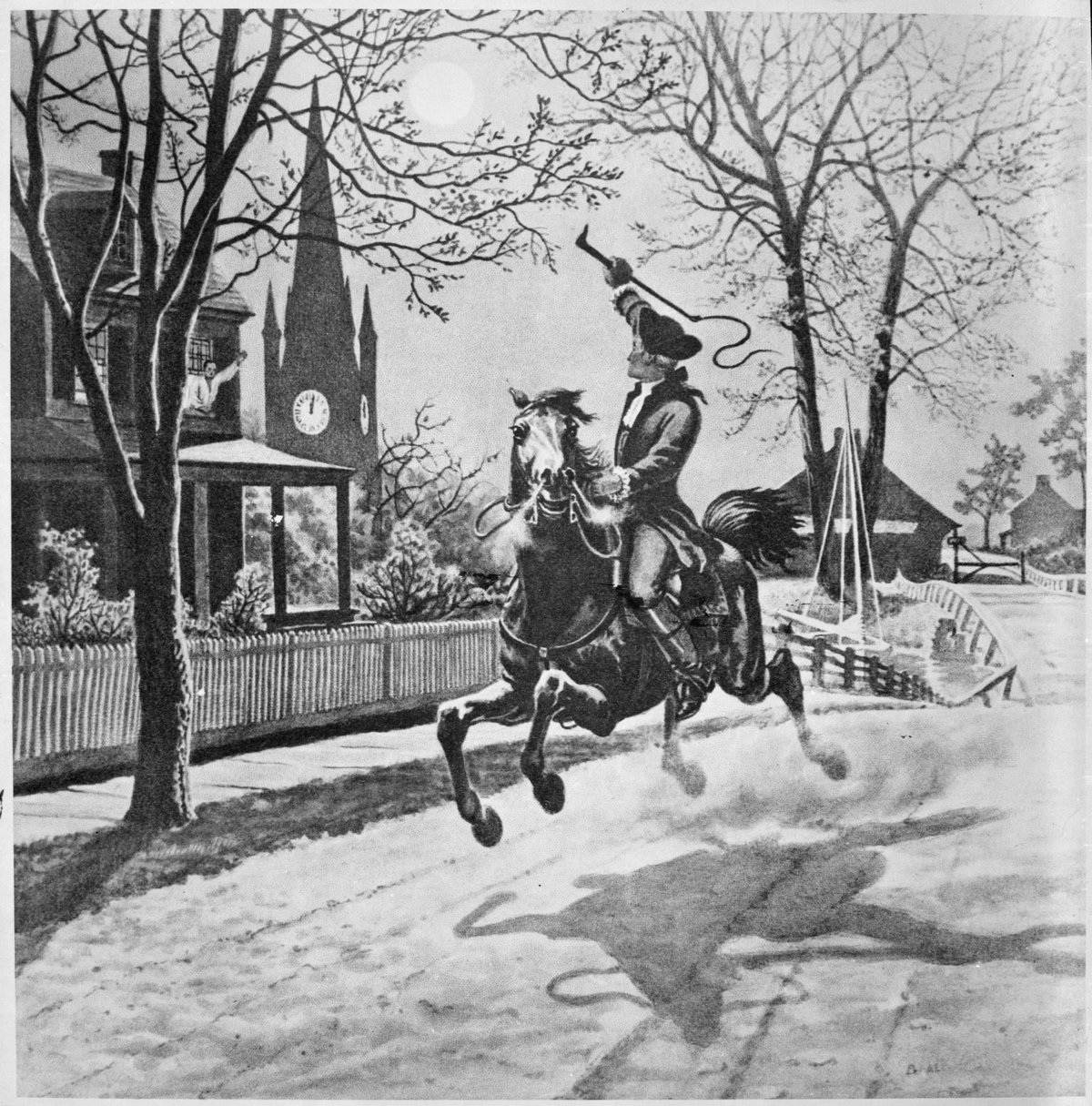
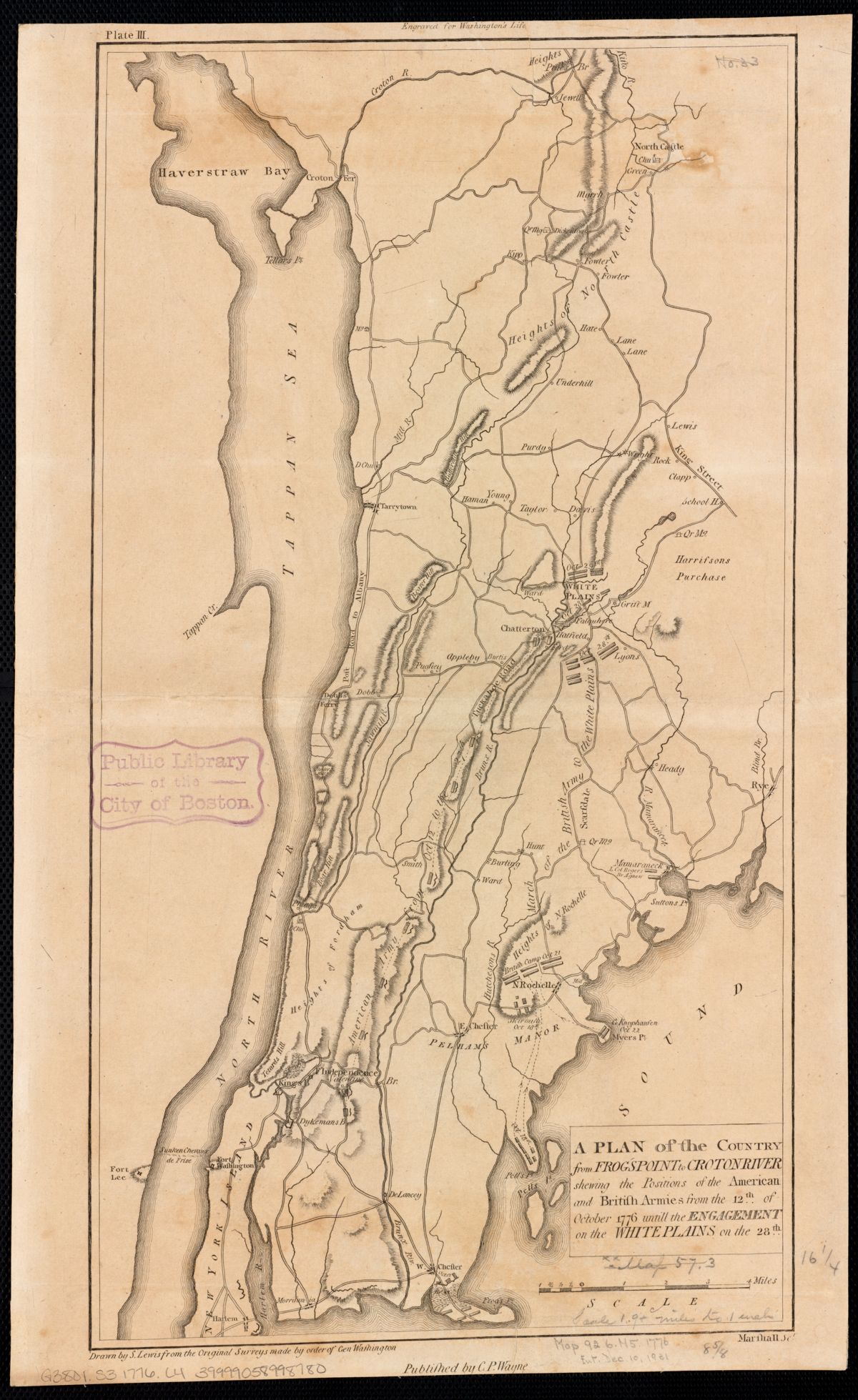
- teatown_horseback.jpg — Colonial-era horseback riders. NARA illustration, public domain. Used in the header as the canonical illustration of the tea-raid tradition. - ny_province_1776_map.jpg — Map of the Province of New York during the Revolutionary War era, showing Westchester County as the contested "Neutral Ground" between the American and British lines. Public domain. - bpl_frogspoint_croton_1776.jpg — Revolutionary War military map showing American and British army positions from Frog's Point to the Croton River, October 12–28, 1776. Boston Public Library collection, public domain. Used to show the tactical geography of the Lower Hudson in the year of the tea raid. - sauthier_1778_ny_province.jpg — Claude Joseph Sauthier's detailed 1778 map of the Province of New York showing Westchester County, the Van Cortlandt and Philipse manors, and the North River Turnpike. Public domain. - WCHS manuscript page facsimile, item 1019 — The actual handwritten page on which Talman Orser's "Sarah Orser, wife of Albert Orser" testimony appears. Directly viewable at [collections.westchestergov.com/digital/collection/mcdonald/id/1019](https://collections.westchestergov.com/digital/collection/mcdonald/id/1019). This is the evidentiary document for the central correction in this article.
A note on method. This article was drafted by the primary researcher and then sent in full to an independent software-agent reviewer — a separate instance of Claude, operating on the source materials alone, without access to the draft — with instructions to locate every factual claim in the primary sources and flag any that could not be verified from the manuscripts or from the secondary literature. The reviewer's corrections were folded back into the draft before publication. Both passes are logged in the project's `claude-progress.txt`. If you believe any claim above is wrong, please tell us: we would rather be corrected than be stale.
Photo3: ny_province_1776_map.jpg — Province of New York (1776), showing Westchester as the contested Neutral Ground. Photo4: sauthier_1778_ny_province.jpg — Sauthier's 1778 map of the Province of New York with the North River Turnpike and the Van Cortlandt and Philipse manors.