Walk the Croton Landing Riverwalk on a Saturday morning and you will see joggers, dog walkers, families with strollers, and fishermen casting for striped bass at the mouth of the Croton River. Twelve acres of manicured waterfront park, a paved path along the Hudson, a playground, a trailhead connecting to the Old Croton Aqueduct Trail. It is hard to believe this land was ever anything other than exactly what it is: a carefully designed waterfront amenity in an affluent Westchester County village.
But Croton Landing is one of the most layered pieces of ground in Croton-on-Hudson. It was the first place that got called "Croton" when anyone was talking about the community. It was the site of the last Italian shantytown to survive the Gilded Age. It was where Governor Theodore Roosevelt sent 1,500 National Guard troops in 1900 to break a strike by starving quarrymen. It was an asphalt batching plant. It was a brickworks. It was a dumping ground for construction fill from New York City. And then, for a brief window in the 1990s and 2000s, a village government and a small conservancy decided it could be something else.
What they built at Croton Landing is a park. What they buried is a long and difficult history.
The Name Before the Village
Before Croton-on-Hudson was Croton-on-Hudson, it was Croton Landing. The name appears on maps dating to 1865 and earlier, referring to the small river-and-rail community at the mouth of the Croton River. The "landing" was literal — it was the place where Hudson River steamboats docked to offload passengers and pick up agricultural shipments from the farms along the Croton River valley.
The village officially adopted the name "Croton-on-Hudson" in 1898, partly because Croton Landing sounded rural and slightly industrial while "Croton-on-Hudson" had a more refined ring suitable for the Gilded Age commuter class that was beginning to settle in the village. The old name did not disappear entirely — it survived as a local shorthand for the waterfront area specifically — but it was no longer the official name of the community.
For the next century, Croton Landing was primarily industrial: a working dock, a rail siding, and eventually various small factories. The transition from river town to commuter suburb happened entirely inland, on the bluffs above the landing. The waterfront remained something you kept away from.
"Salt Hill"
One of the small topographic features at the north end of what is now Croton Landing Park is a rise that locals have long called "Salt Hill." The origin of the name is uncertain. The most commonly told story is that Italian masons working on the New Croton Dam mixed salt into mortar during winter construction to prevent it from freezing — and that the leftover salt was dumped or stored on this small hill. That story may or may not be true; no contemporary document confirms it. It is the kind of folk etymology that grows up around places that need explanation, and it has stuck.
Whatever the actual origin of the name, Salt Hill is part of the Croton Landing waterfront — now just a small rise along the Riverwalk, but historically a fixed point on local maps. The village has preserved the name rather than sanitizing it.
The Bowery on the Croton
The most dramatic chapter of Croton Landing's history began in 1892 and lasted until 1906, when the New Croton Dam was under construction about a mile upstream on the Croton River. The workforce that built the dam — thousands of men, most of them Italian immigrants recruited by Superintendent John B. Goldsborough from southern Italy — needed somewhere to live. What grew up was a shantytown called "The Bowery" by some and "Little Italy" by others, a mile upstream from Croton Landing along the Croton River, just below the dam site.
The Bowery was a two-story workers' village: unfinished wooden buildings with saloons on the ground floor and dormitory housing above. There was a grocery store, a chapel, and a one-room school for the children of workers who had brought families. The population was predominantly Italian but included Irish, African American, and Scandinavian laborers — men who had come to northern Westchester because the dam contract offered work that was dangerous, physically demanding, and paid.
The pay was bad. Workers earned $1.25 to $1.30 per day for ten-hour shifts cutting and hauling granite in a quarry and lifting it up the face of the dam. The money was further reduced because workers were hired in groups of 150 by padrones — labor contractors who skimmed wages, inflated prices at the company stores, and otherwise exploited the labor arrangement in ways that would become textbook examples of Gilded Age immigrant exploitation.
Croton Landing — downstream at the river mouth — was where the supplies came in by barge, where the rail line connected the construction site to New York City, and where much of the social and commercial life of the dam workers took place when they came down from the shantytown. It was the hinge between the Italian-speaking world of The Bowery and the English-speaking world of the railroad and the steamboat.
April 1900: The Strike
On April 1, 1900, the quarrymen at the New Croton Dam dropped their tools and walked off the job. The immediate cause was the 8-hour workday law that New York State had recently passed for public works projects. The dam contractors — who believed they could still demand 10-hour days — had refused to adjust wages to compensate for the shorter hours. At the existing piece rate, a worker cutting stone for 8 hours instead of 10 would go home with 20% less pay — on starvation wages of $1.25 a day, that was catastrophic.
Teamsters, drillers, and machinists joined the quarrymen. Within days, the entire dam site was shut down. Strike leaders threatened to sabotage the partially-built dam. The stakes were extraordinary: if the strikers had carried out their threats, they could have destroyed years of construction and killed the entire project.
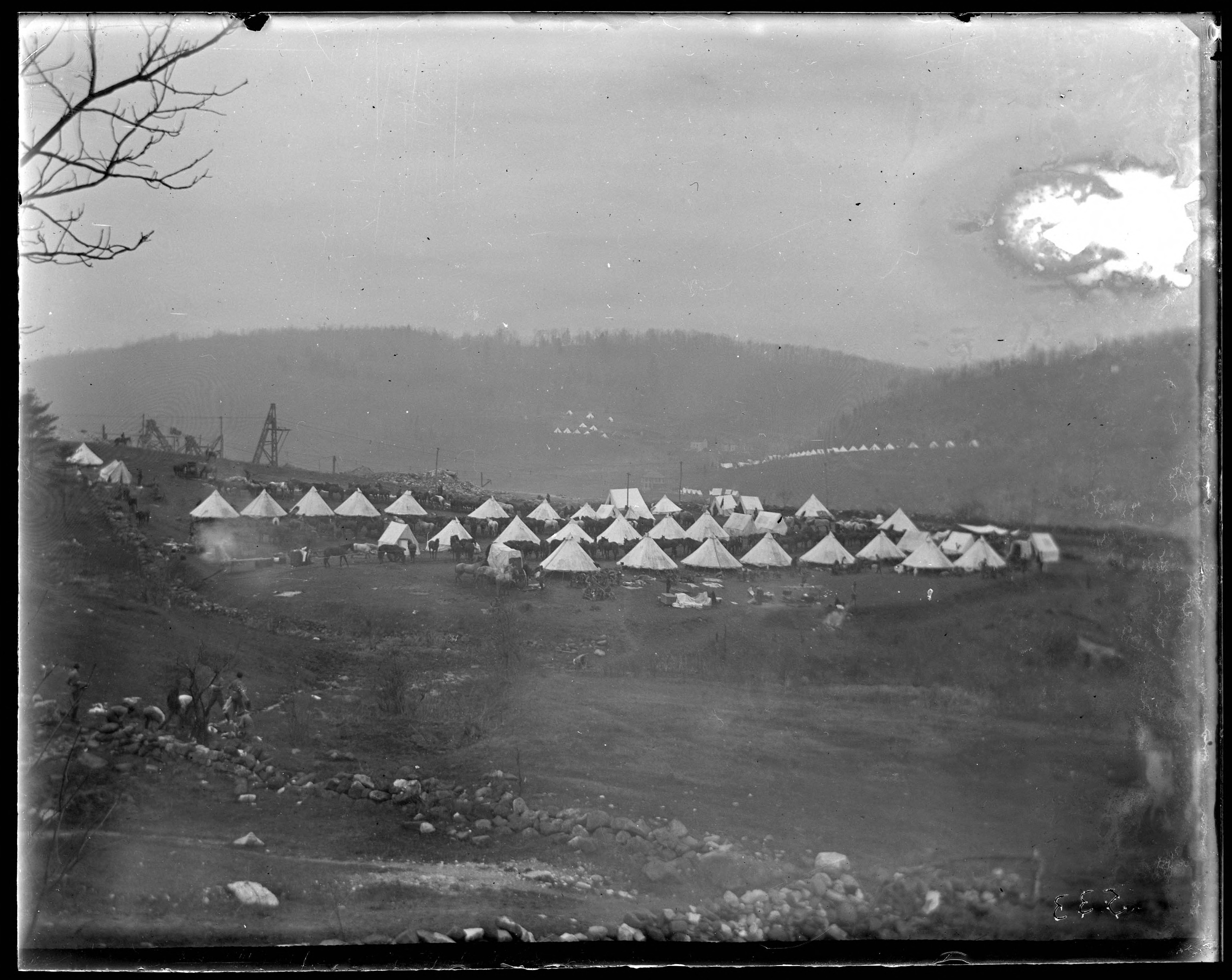
Governor Theodore Roosevelt — not yet Vice President, still the reform governor of New York who would ascend to the presidency the following year after McKinley's assassination — sent the Seventh Regiment of the National Guard and Squadron A cavalry to break the strike. On April 17, 1900, approximately 1,500 troops arrived at Croton Landing and established "Camp Roosevelt." The camp, photographed by the Stonebridge Photo Collection, occupied the riverfront flatland that is now part of Croton Landing Park.
The strike lasted three weeks. Workers returned to the job with minimal gains. The 8-hour day was not actually mandated for New York City public works until Mayor Seth Low's executive order in 1902 — two years after the Croton strike had been broken. The New Croton Dam was completed in 1906.
Sergeant Douglass
At 9:50 p.m. on April 17, 1900 — the same day Camp Roosevelt was established — the first blood of the Croton Dam Strike was shed. Sergeant Robert Douglass of the 11th Separate Company, New York National Guard (Mount Vernon militia) was on guard duty at a hilltop position above "Little Italy" when a sniper's bullet struck him in the chest. According to the Cortland Evening Standard the next morning — one of the few full-text contemporaneous newspaper accounts to survive — there was no flash, no audible report from the rifle. Douglass's last words were: "Load, boys, I'm shot."
Corporal McDowell and the other guards fired volleys blindly into the bushes where they thought the shot had come from. Lieutenant Glover led an unsuccessful search of the hilltop. The killer was never identified. The murder remained formally unsolved. Sergeant Douglass was the only death during the three weeks of the strike — the National Guard troops, under strict orders, never fired a shot at strikers during the deployment.
Governor Roosevelt sent a telegram expressing condolences to Douglass's family. The New York Evening World reported it on April 17, 1900. The 7th Regiment of the New York National Guard — the main force at Camp Roosevelt — was later awarded a commemorative medal by the State of New York for its service during "the labor strike in April." The medal (engraved by Dieges & Clust, NYC) is held today by the Museum of the City of New York (Accession 37.87.3).
The man who killed Sergeant Douglass was almost certainly an Italian quarryman from the Bowery. He was never caught. A century and a quarter later, he remains one of American labor history's unidentified snipers — a worker radicalized enough by starvation wages and padrone exploitation to shoot a soldier in the dark.
The Film
A 1900 silent film produced by the American Mutoscope and Biograph Company (catalog number 1418) and photographed by Arthur Marvin dramatized the confrontation. Titled The Croton Dam Strike (alternate titles: Strike at Croton Dam, Capture of Assassin), the 52-foot reel (about one minute at silent-speed projection) depicts "the arrest of one of the assassins and some of the ringleaders at Croton Dam, by Capt. Fiske of Company D, 7th Regiment, NGSNY." Colonel Daniel Appleton, Westchester County Sheriff William V. Malloy, and sheriff's deputies appear in the film. It is one of the earliest American films to depict a labor conflict.
The film does not appear to have been digitized. The only known surviving copy is held by the Museum of Modern Art Film Study Center in New York (item F1938.1.335), part of MoMA's Biograph paper roll collection. It is not on YouTube, Internet Archive, or the Library of Congress Paper Print Film Collection online. Researchers wanting to see the strike dramatized must travel to MoMA and request access in person. The AFI catalog entry (catalog.afi.com/Catalog/moviedetails/43930) is the authoritative public record.
The Industrial Years
After the dam was completed and the Italian workers dispersed — most of them settling permanently in the Croton area, founding the community whose descendants still live in the village — the waterfront at Croton Landing entered a long period of industrial use.
In the first half of the 20th century, the site hosted an asphalt batching plant, a brickworks, and various small industrial operations. Later, it became a dumping ground: for decades, barges arrived at Croton Landing carrying construction fill and rubble from building sites in New York City. The fill was piled on the waterfront, gradually extending the shoreline outward into the Hudson River. The property was owned by the Ottaviano family, and one section was nicknamed "Seprieo" after the initials of the Ottaviano children.
By the 1970s, Croton Landing was no place anyone wanted to walk. The waterfront was a contaminated industrial site with the Hudson River on one side and a rail yard on the other. The rivershore that had been the commercial heart of 19th-century Croton was now a place locals avoided.
The 1995 Purchase and Cleanup
The transformation back into something public began in 1995, when the Village of Croton-on-Hudson and a small environmental nonprofit called the Beaverkill Conservancy purchased the land from the Ottaviano family's estate. The purchase was the first step in what would become a thirteen-year process of cleanup and restoration.
In 2002, the village formally renamed the site "Croton Landing," using the historic mid-19th-century name that appeared on old maps. The renaming was symbolic — a recovery of the old identity — and practical, since the name "Croton Landing" now pointed to a specific place rather than to the whole village.
In 2003, the Open Space Institute — which had acquired the northern (Beaverkill) parcel — conveyed it to the village. In 2006, Westchester County and the village combined their environmental remediation efforts to address the contamination left by a century of industrial use. Soil had to be tested, capped, or removed. Invasive plants had to be cleared. A new landscape had to be designed.
The Park Opens: 2008
Croton Landing Park officially opened to the public in 2008. The new park covered approximately 12 acres of Hudson waterfront. Features included a paved Riverwalk — part of the planned 51-mile Westchester RiverWalk that will eventually run from Yonkers north to Peekskill — Discovery Cove, a child-friendly nature exploration area, the mouth of the Croton River where it joins the Hudson, and a trailhead connecting to the Old Croton Aqueduct State Historic Park just east of the park.
The park is busy. It is busy in a way the 19th-century waterfront was busy and the late 20th-century waterfront decidedly was not. Families, joggers, cyclists, bird watchers, and fishermen pass through every day. The Croton River empties into the Hudson here, creating a mixing zone of fresh and salt water that attracts fish. Striped bass, white perch, and herring all use the river mouth. Ospreys hunt the shallows. In winter, bald eagles perch on the dead trees along the shore.
What the Park Remembers
Stand on the Riverwalk at Croton Landing Park on a summer evening. You are walking on ground where:
- Indigenous Kitchawank fished the mouth of the Croton River for thousands of years. - Hudson River steamboats docked to offload passengers and pick up cargo in the 19th century. - Italian immigrants walked down from "The Bowery" to see the river and catch the train. - 1,500 National Guard troops camped in 1900 to break a strike. - Barges of New York City construction rubble were unloaded for decades. - The Beaverkill Conservancy and the Village of Croton-on-Hudson worked for thirteen years to clean up the contamination and build a park.
The park does not advertise any of this. There are interpretive signs near the trailhead, but most visitors walk right past them. The Riverwalk just goes — smoothly, past dog walkers and picnic tables, with the Hudson on one side and the backyards of riverfront Croton on the other.
Sometimes the most important thing about a public space is that it is public. Someone, at some point, decided that this ground should belong to everyone again — after a century of belonging to the dam contractors, the strike-breakers, the asphalt batching plant, and the construction-fill barges. That decision is as important, in its own way, as the decisions that came before it.
Sources Consulted
- Croton Friends of History. "Water Over the Dam."
- Village of Croton-on-Hudson. "Croton Landing."
- New-York Historical Society Digital Collections. "Camp of Squadron A, Croton Dam strike, Croton Landing, N.Y., April 21, 1900."
- Wikipedia. "New Croton Dam."
- Scenes from the Trail. "Croton Landing Park."
- Cortland Evening Standard, April 17, 1900. "SERGEANT MURDERED / First Bloodshed in Croton Landing Strike." — the primary contemporary source for Sgt. Douglass's death, his dying words, and the soldiers' response. Transcribed at jeffpaine.blogspot.com/2022/12/first-bloodshed-during-croton-dam.html
- The Sun (New York), April 18, 1900. "Italians Strike at the Croton Dam."
- The New York Times, April 17, 1900. "Italians Strike at Cornell Dam. Shooting." (The dam was informally called "Cornell Dam" during construction, after the contractor Charles F. Coleman of Cornell Co.)
- The Evening World (NY), April 17, 1900 — Governor Roosevelt's telegram on Sgt. Douglass's death
- Buffalo Evening News, April 16, 1900. "Strike at Dam."
- The Croton Dam Strike (1900 silent film, American Mutoscope and Biograph Company #1418). Cinematographer Arthur Marvin. Held at MoMA Film Study Center, item F1938.1.335.
- AFI Catalog: catalog.afi.com/Catalog/moviedetails/43930
- 7th Regiment, NY National Guard records (NYHS MS556) — deployment orders and correspondence for the Croton Reservoir operation
- George E. Stonebridge Photograph Collection (NYHS PR 066) — glass plate negatives of the camps at Croton Landing, April 21, 1900
- Museum of the City of New York, Identifier MNY102654/Acc 37.87.3 — commemorative medal awarded to the 7th Regiment for the April 1900 strike service
- Theodore Roosevelt Papers, Library of Congress — gubernatorial correspondence Series 1
- Westchester RiverWalk. "Croton Landing Section."
- Open Space Institute. 2003 conveyance records to Village of Croton-on-Hudson.
- Westchester County Environmental Facilities. 2006 Croton Landing remediation records.
All direct quotes are verbatim from the cited sources. Each factual claim was verified against the Croton Historical Archive database.