On October 14, 1842, New York City staged what contemporaries called "the greatest jubilee that New York has ever boasted." A parade of unprecedented length wound through Manhattan. Fountains erupted for the first time. Fire companies demonstrated their new hydrant connections. And in front of the Park Fountain, members of the New York Sacred Music Society rose to sing an ode written for the occasion by the city's most celebrated poet.
The occasion was the arrival of Croton water — clean, fresh water from the Croton River, forty-one miles north, delivered by gravity through what was then one of the greatest engineering achievements in the world. For a city that had suffered devastating epidemics of cholera and yellow fever, fueled by contaminated wells and stagnant cisterns, the moment was nothing short of miraculous. And like all miracles, it demanded poetry.
What follows are six poems written about Croton water — presented here in full, with the context that gave them meaning.
The Official Ode: George Pope Morris
The Corporation of the City of New York commissioned George Pope Morris to write the official celebration poem. Morris was the natural choice. Born in Philadelphia in 1802 but a New Yorker by adoption, he was the co-founder of the New York Evening Mirror — the newspaper that would, three years later, publish the first credited appearance of Edgar Allan Poe's "The Raven." Poe himself praised Morris as "our best writer of songs." Morris's most famous work, "Woodman, Spare That Tree!" (1837), set to music by Henry Russell, had become one of the most quoted poems in America — and its environmentalist sentiment would resonate differently in a valley where an entire river was being redirected to slake a city's thirst.
For the Croton celebration, Morris wrote "The Croton Ode," set to music by Sidney Pearson on a chorus from Rossini's Armida. The ode was printed on broadsides distributed during the parade and sung in front of the fountain as water surged into the air for the first time. Here is the complete poem as it appeared in Charles King's Memoir of the Construction, Cost and Capacity of the Croton Aqueduct (1843):
Morris imagined the Croton water as a classical goddess — an oread, a mountain nymph — attended by naiads and woodland fays, traveling from her "haunts of deep seclusion" to save the city. The poem is lush with mythological imagery: coral shallops, foam-beads, Eden's arch. But beneath the classical veneer lies a practical civic message. The fourth stanza addresses the temperance movement directly — "Let Intemp'rance greet her too, / And the heat of his delusion / Sprinkle with this mountain-dew" — while the fifth celebrates water's defeat of the city's real enemies: disease and fire. The sixth stanza reaches for biblical grandeur, comparing the moment to Moses striking the rock. And the seventh amounts to a prophecy — that Croton's water will outlast everything else.
Morris died in 1864. The Home Journal, which he co-founded with Nathaniel Parker Willis, eventually became Town and Country magazine — still published today.
Morris's Summer Plea: "The Dog-Star Rages"
Morris wrote at least two other poems that reference Croton and the Hudson Valley. "The Dog-Star Rages," a comic poem about surviving summer in New York, imagines the city wilting under August heat until only one thing can save it — Croton water. The final stanza:
Even in a humorous summer poem, Croton water is the answer to New York's suffering. The mock-heroic closing — "God save the Corporation!" — captures how deeply the aqueduct had become woven into the city's civic identity. Water was not just infrastructure; it was something you could pray for.
Morris's Highland Romance: "Where Hudson's Wave"
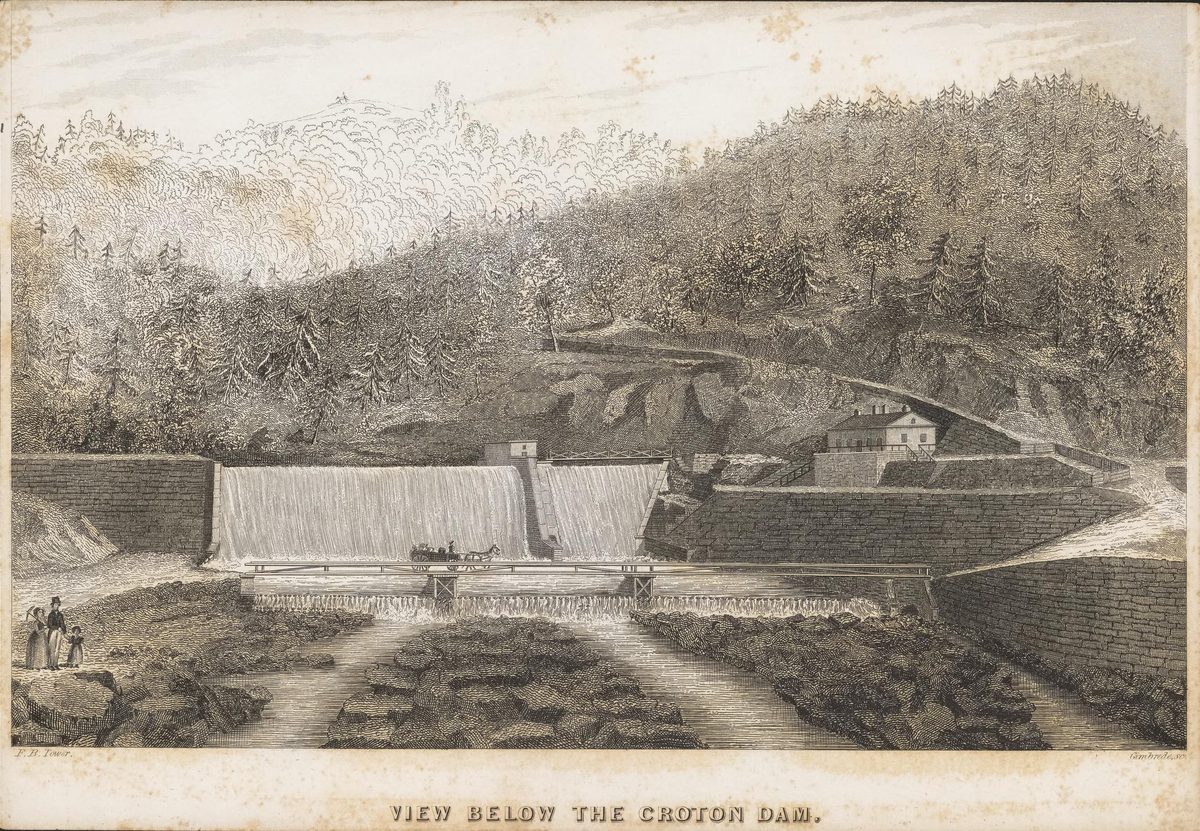
Morris's romantic lyric "Where Hudson's Wave" — which a contemporary critic called "a glorious burst of poetry" — describes the highlands near Croton. "Old Cronest" is Storm King Mountain, the dramatic peak that commands the Hudson at the northern gate of the Highlands:
The phrase "rock-ribbed" appears in both this poem and the Croton Ode — a signature image for Morris, linking the Highlands landscape to the aqueduct that emerged from it.
The Children's Poem: Lydia Maria Child
If Morris wrote the official poem for adults, Lydia Maria Child wrote the one that mattered to children. Her "The New-York Boy's Song," written around 1842 and published in 1854 in Flowers for Children, became the Croton water's popular anthem.
Child was not a minor figure. Born in Medford, Massachusetts in 1802 — the same year as Morris — she was one of the most important American writers of the nineteenth century. Her 1833 book An Appeal in Favor of that Class of Americans Called Africans was a landmark abolitionist text. She became the first woman to edit a national political newspaper when she took over the National Anti-Slavery Standard in 1840 — and it was during her years in New York, from 1840 to 1844, that she witnessed the Croton water's arrival.
She is perhaps best remembered today as the author of "Over the River and Through the Wood" — the Thanksgiving poem that every American child learns. Her Croton poem has the same quality: deceptively simple, written for children, carrying a moral weight that reveals itself slowly. Here is the complete poem:
Child appended a note to the poem: "In former years, water was very scarce and very bad, in some parts of the city of New-York. But now an abundance of delicious water is brought from the river Croton, forty miles off. It runs under-ground, in big iron pipes. In every street, are conductors, called hydrants, from which small streams flow continually."
In a children's poem, Child embedded the temperance argument that drove much of the aqueduct's political support. Clean water was not just an engineering achievement — it was a social reform. The verses move from ragged children washing their faces to dogs at hydrants to horses drinking — and then, suddenly, to "many a drunkard has forgot / To seek the fiery cup." The poem's refrain — "It flows for man and beast, / And gives its wealth out freely, / To the greatest and the least" — frames water as a democratic resource, available to the poorest as equally as the richest. For an abolitionist writing during the era of slavery, the phrase "the greatest and the least" carried resonance beyond plumbing.
Child was also an advocate for Native American rights. Her 1868 Appeal for the Indians helped create the U.S. Board of Indian Commissioners. There is an unrecorded irony in her celebration of the Croton: the river bore the name of Kenoten, a Kitchawank sachem, and the aqueduct was built through territory from which the Kitchawank had been displaced. Whether Child knew this is uncertain. But her sensitivity to indigenous dispossession, demonstrated elsewhere in her work, suggests she might have appreciated the complexity of celebrating a river named for a people who had been erased from it.
The Recovered Ode: Jonas B. Phillips
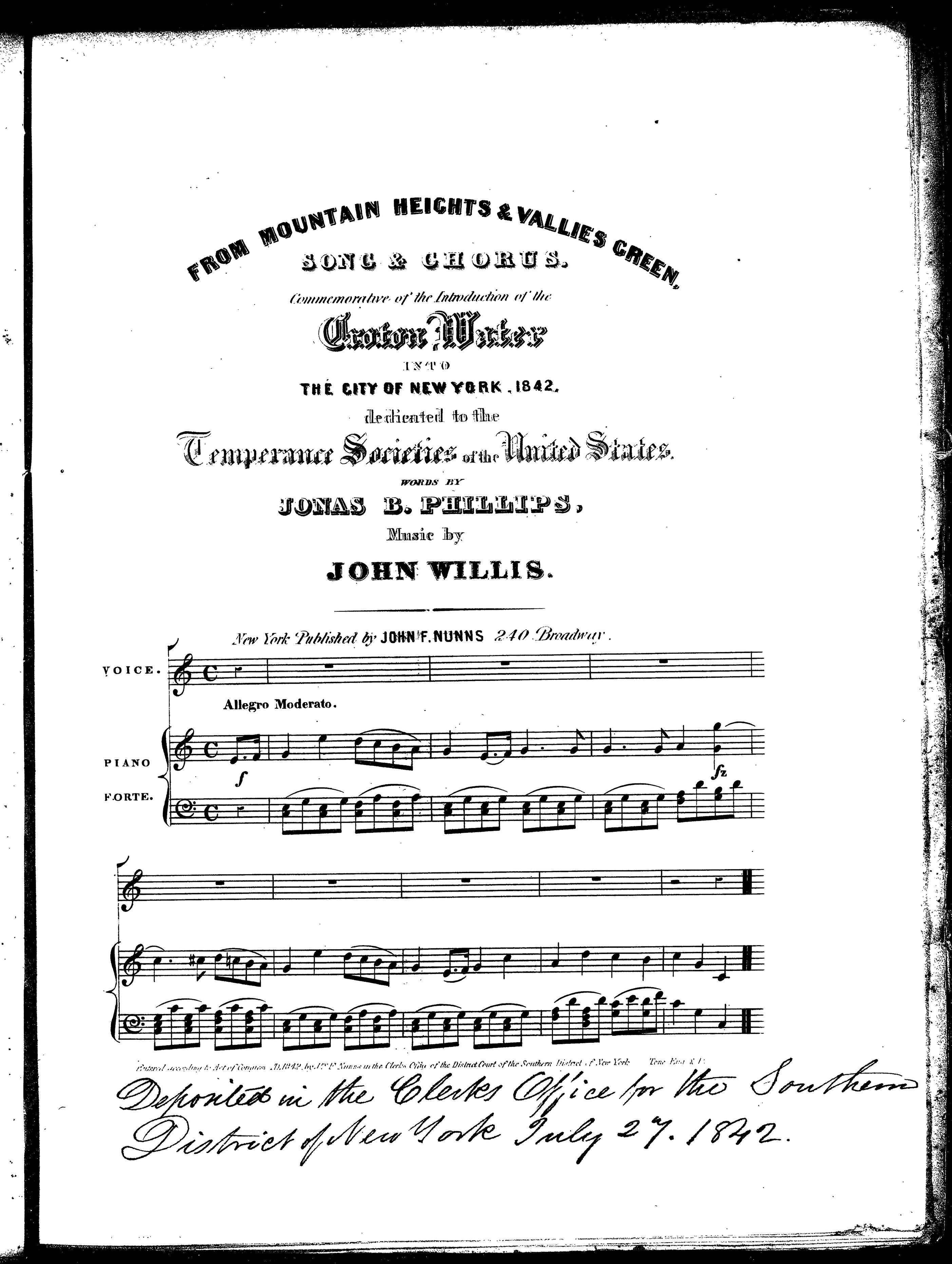
There was another major poem written for the 1842 celebration — one that was long considered lost. "From Mountain Heights & Vallies Green" by Jonas B. Phillips, set to music by John Willis, was a "Song & Chorus Commemorative of the Introduction of the Croton Water into the City of New York, 1842." It was dedicated to the Temperance Societies of the United States and published by John F. Nunns at 240 Broadway. The copyright was deposited in the Clerk's Office for the Southern District of New York on July 27, 1842.
The original sheet music — five pages of voice and pianoforte in Allegro Moderato, with a three-part trio chorus — was digitized by the Library of Congress Music Division. The lyrics, transcribed from the scanned pages, reveal a temperance anthem that treats Croton water as divine deliverance. Here is the complete song:
Where Morris mythologized water as a classical goddess, Phillips framed it as a weapon against alcohol — "the madd'ning bowl." The song was written for three-part chorus — first voice, second voice, and bass — with piano accompaniment. It was meant to be sung communally, by temperance societies at their meetings, with the crowd joining on the chorus. If Morris's ode was the establishment's poem, sung by professionals at the official celebration, Phillips's was the people's song, designed to be carried home and repeated.
The Nikko Tea House Verse: C.K. Nazu
Sixty-five years after the water celebration, poetry about Croton took a very different form. Around 1907, C.K. Nazu — manager of the Nikko Tea House in Harmon-on-Hudson — composed a verse for a promotional postcard:
It is not great poetry. But it is a genuine artifact of its moment — the automobile age arriving in a village that had been, within living memory, indigenous territory. "The wooded Croton's brink" echoes, however faintly, the landscape that Lossing sketched and Morris mythologized. The Nikko Tea House itself would become a speakeasy during Prohibition, raided by federal agents who went undercover as musicians. Nazu's innocent postcard verse belongs to the last moment before the Jazz Age transformed the quiet riverside into a bootlegger's playground.
What the Poems Tell Us
Read together, the six Croton poems trace an arc from civic grandeur to social conscience to commercial charm. Morris's ode treats water as classical mythology — nymphs and naiads, Rossini and broadsides. His "Dog-Star Rages" makes it comic salvation; his "Where Hudson's Wave" roots it in romantic landscape. Child's poem treats water as justice — clean faces for ragged children, freedom from the "fiery cup." Phillips's song treats it as divine deliverance from the "madd'ning bowl." Nazu's verse treats it as real estate — "the situation picturesque; the food is fine we think."
Each poem is honest about what Croton meant to its moment. In 1842, it meant salvation — from disease, from fire, from the indignity of fouled wells. By 1854, when Child published her poem, it meant equality — water "for man and beast," "to the greatest and the least." By 1907, it meant amenity — a scenic river, a tea house on its brink, a road you could drive on with your friends.
The Croton River still flows. The aqueduct still stands. The poems survive in archives, on postcards, and in the pages of a children's book by an abolitionist who understood that clean water was a form of freedom.
Sources Consulted
- Child, Lydia Maria. "The New-York Boy's Song." *Flowers for Children* (1854). Internet Archive.
- King, Charles. *A Memoir of the Construction, Cost and Capacity of the Croton Aqueduct* (1843). Internet Archive. Full text of "The Croton Ode."
- Morris, George Pope. "The Croton Ode," "The Dog-Star Rages," "Where Hudson's Wave." *Poems* (1853). Project Gutenberg.
- Phillips, Jonas B. "From Mountain Heights & Vallies Green." Sheet music (1842). Library of Congress, Music Division. Lyrics transcribed from digitized pages.
- Nazu, C.K. "If You Follow the Road to Harmon." Nikko Tea House promotional postcard (c. 1907). crotonhistory.org.
- Wikipedia, "George Pope Morris" — co-founder of NY Evening Mirror, first publisher of "The Raven"
- Wikipedia, "Lydia Maria Child" — abolitionist, author of "Over the River and Through the Wood"
- crotonhistory.org, "O, blessed be the Croton!" — context on the Child poem
- crotonhistory.org, "Croton's Waves in All Their Glory" — context on the Morris ode and Phillips sheet music
All direct quotes are verbatim from the cited sources. Each factual claim was verified against the Croton Historical Archive database.